Is a TACCIA ball point actually worth $100 when a Uni Jetstream writes well at $15?
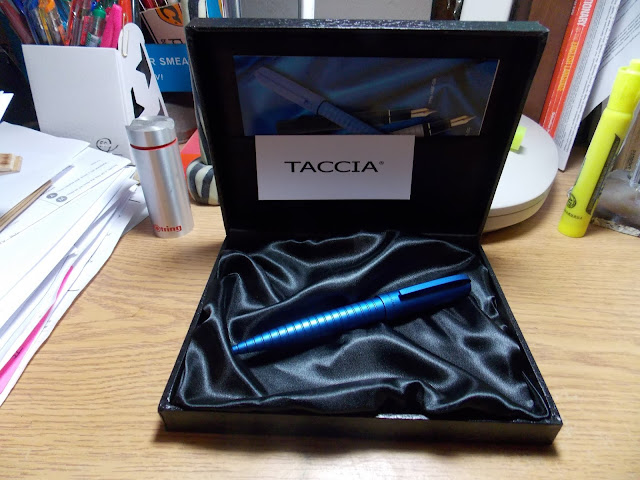
That’s the real question. TACCIA is a Japanese brand with deep roots in traditional lacquer craftsmanship — urushi finishing, careful metalwork, builds intended to last years rather than months. Their ball points enter a market where the competition is cheaper and, in some respects, technically superior at the ink level. The brand doesn’t win on ink engineering. It wins on entirely different terms. Here’s what’s worth knowing before spending.
Note: Writing preferences vary considerably based on paper type, grip habits, and individual biomechanics. The observations here reflect general patterns — your experience may differ. When possible, try a pen before committing to a significant purchase.
What Sets TACCIA Ball Points Apart from Mass-Market Options
Most ball points in the $5–20 range share a common design logic: lightweight body, proprietary refill system, engineered for high-volume production and consistent output. TACCIA approaches the same product category from the opposite direction.
The brand’s reputation is built on urushi lacquer — a traditional Japanese finishing technique involving successive thin coats of natural lacquer, each layer cured fully before the next is applied. This process typically takes several weeks per piece and produces a surface that’s considerably harder and more scratch-resistant than painted or powder-coated finishes found on mass-market metal pens. Under daily use conditions, a well-maintained urushi finish generally holds its appearance far longer than comparable alternatives. That’s not a marketing claim — it’s a material reality with direct implications for a pen you intend to carry every day for years.
Weight, Balance, and What Happens Over Two Hours of Writing
The TACCIA Miyabi Ball Point Pen weighs approximately 22–26 grams capped — roughly double the weight of a Pilot G2 at around 12 grams, and noticeably heavier than the Uni Jetstream Standard at approximately 13 grams. For quick signatures or brief task lists, that weight difference is irrelevant. For students in multi-hour lectures or writers doing extended longhand drafts, heavier pens typically require less grip pressure to maintain control — which reduces hand fatigue over time in ways that are hard to notice until you switch back to something lighter.
The center of gravity on most TACCIA models sits closer to the grip section rather than the cap end. This generally produces a more controlled writing stroke, though balance preferences are highly individual. What feels well-weighted to one person feels front-heavy to another depending on grip style and hand size.
The Refill System — Why It Matters More Than Most Buyers Expect
Most TACCIA ball point models use Parker-compatible G2 refills. This is the same cartridge standard found in Parker Jotters, many Monteverde bodies, and dozens of other mid-range pen lines globally. Parker G2 refills are among the most widely available refill formats in the world — stocked at most office supply retailers, available from multiple competing suppliers, and typically priced at $5–10 for a two-pack.
In practice this means two things. You’re not locked into a proprietary supply chain. And you can swap in refills from Schmidt, Parker, or Monteverde — each with slightly different ink characters — giving you meaningful flexibility across the pen’s lifespan. Writers who’ve already established a preferred refill brand find this genuinely useful. Students who just want something reliable and easy to replace benefit equally.
The critical clarification: TACCIA ball point bodies deliver ergonomics, materials, and build quality. The writing character on paper is determined entirely by the refill you choose. A Schmidt P900M in a TACCIA Miyabi writes identically to the same Schmidt P900M in a $25 Parker Jotter. The body changes what the pen feels like in your hand — not what it produces on the page.
TACCIA Models Compared: Miyabi, Spectrum, and Nishiki
Three models appear most consistently in discussions about TACCIA ball points. Here’s a direct comparison on the specifications that actually inform a purchase decision:
| Model | Price Range | Finish | Approx. Weight (capped) | Refill Standard | Best For |
|---|---|---|---|---|---|
| TACCIA Miyabi | $100–$160 | Urushi lacquer, multiple colorways | 22–26g | Parker G2 | Daily carry, decade-long investment, extended writing sessions |
| TACCIA Spectrum | $50–$80 | Resin/lacquer hybrid, lighter build | 17–20g | Parker G2 | Students, everyday carry, first premium ball point |
| TACCIA Nishiki | $80–$120 | Traditional lacquer, decorative patterning | 20–24g | Parker G2 | Collectors, aesthetics-focused buyers, gifting |
The Spectrum is the practical entry point for most buyers. It delivers TACCIA’s build approach and Parker compatibility without requiring the full Miyabi investment. For students or everyday writers wanting a clear step up from disposables, the Spectrum’s price-to-build ratio typically makes more sense than jumping immediately to the flagship.
The Nishiki occupies an interesting position — priced above the Spectrum but with a primarily decorative distinction. The traditional lacquer patterning is visually striking and makes it a strong gift choice. For buyers optimizing for writing performance rather than aesthetics, the Miyabi or Spectrum are cleaner decisions.
Verdict for most buyers: Start with the TACCIA Spectrum at $50–80. Move to the Miyabi only when you’ve confirmed you want a pen built to last a decade of daily use, not just a year or two.
Practical tip before any premium pen purchase: buy a single Parker-compatible refill (around $4–6) and try it in whatever Parker-compatible pen you currently own. That writing experience is approximately what you’ll get from any TACCIA body. The body changes how the pen feels in your hand — the page output stays the same. This test costs almost nothing and tells you exactly what to expect.
Tip Size and Paper Type — What Actually Changes on the Page
No premium pen body compensates for a tip size that doesn’t fit your handwriting or paper. This applies across every brand and price point, and sorting it out before purchase costs nothing.
0.5mm vs. 0.7mm — Which Situation Calls for Which
A 0.5mm ball point produces finer lines with less ink spread per stroke. It’s better suited to small-format notebooks, dense marginal annotation, writing systems with complex characters that require fine detail, or any situation where you need to fit more text into a limited area. A 0.7mm tip lays down a broader, more visible line — easier to read back at speed, more legible at a distance, and more forgiving of rougher paper texture or uneven pen angle.
For standard A5 or letter-format notebooks, either tip size typically works without issue. For pocket-format notebooks with limited page space, 0.5mm generally produces cleaner, less visually crowded output per page. If you’re genuinely unsure which to start with, 0.7mm is the safer default — it adapts to more paper types without requiring adjustment to writing pressure or technique.
One thing many first-time fine-tip users don’t anticipate: switching from 0.7mm to 0.5mm for the first time requires a brief adjustment period. The finer tip benefits from a slightly lighter touch and benefits from slower horizontal movement. Most writers adapt within a day or two of regular use.
Oil-Based vs. Hybrid Ink — What Each Does on Paper
Traditional ball point ink is oil-based and higher viscosity than gel or hybrid formulations. It performs reliably on cheaper paper that gel pens bleed or feather through — a genuine practical advantage for students using standard spiral notebooks or budget composition books. It requires slightly more writing pressure than lower-viscosity alternatives, and lines typically appear slightly less saturated immediately after writing, darkening slightly as the ink settles.
Hybrid ball point inks combine oil-based stability with reduced viscosity. The writing feel is noticeably different: less pressure required, slightly glossier line, faster feedback on the page. Whether that’s preferable is personal. Some writers find it too frictionless; others actively prefer the lighter hand required. The point is that this difference is about the refill, not the pen body.
Matching Ink to Paper Weight
Oil-based ball point ink generally performs better on lighter-weight or rougher paper. On smoother, heavier stock, the writing feel from a hybrid-formula refill tends to be noticeably more satisfying. If most of your writing happens in budget or student-grade notebooks, a standard oil-based refill is typically the stronger match. If you write primarily in higher-quality paper, a hybrid-formula refill in the same Parker-compatible body may produce better results — and swapping is a straightforward $5–8 experiment.
Practical tip: the paper you use most should inform your refill choice as much as your pen body choice. A premium pen with a mismatched refill on the wrong paper produces a worse experience than a basic pen with the right refill on paper it suits.
When a $15 Pen Is the More Honest Recommendation
If writing performance alone is the criterion, the Uni Jetstream Standard ($10–15) and Pilot Acroball ($8–15) are genuinely difficult to beat at their price points. Both use proprietary hybrid ink systems engineered specifically for smooth, fast output. The Uni Jetstream Prime ($25–35) adds a quality metal body to that same ink system at roughly one-quarter the cost of a TACCIA Miyabi.
For a student who loses pens regularly, writes primarily in cheap spiral notebooks, or cares only about what comes out of the tip rather than how the pen feels in the hand over years of use, recommending a TACCIA on writing-performance grounds is typically a difficult argument. The honest framing: TACCIA is for buyers who value what the body is made of, how long it will last, and the experience of using a well-crafted object daily — not just ink output. Both priorities are legitimate. They’re just different.
What New Buyers Consistently Get Wrong
- Assuming the body determines how the pen writes. The most persistent mistake in the premium ball point category. A beautifully crafted body with a depleted or low-quality refill writes worse than a basic pen with fresh ink. The body determines ergonomics, durability, materials, and how the pen feels to hold. The refill determines what reaches the paper. Before concluding any premium ball point “doesn’t write well,” replace the refill with a known-good alternative and test again.
- Skipping the tip size decision entirely. Buyers often focus on brand and body materials, then discover post-purchase that the tip size doesn’t suit their handwriting style or paper format. This is fixable with a refill swap — but it’s far easier to settle upfront. Start with 0.7mm if genuinely uncertain; it’s the more forgiving choice for most handwriting styles and paper types.
- Buying without verifying long-term refill availability. Standard Parker G2-compatible refills will almost certainly remain widely available for the foreseeable future. Proprietary refill formats for niche or discontinued pen lines can present supply problems after a few years. For buyers who tend to hold onto pens for years, standard refill compatibility is worth considerably more than it appears at the point of purchase.
- Neglecting basic care for lacquer finishes. Urushi lacquer is genuinely durable, but prolonged exposure to extreme heat — leaving a pen in a hot car through summer, for instance — can affect the finish over time. Carrying a lacquer pen loose in a bag without a sleeve can cause fine surface scratches. A simple pen sleeve or roll addresses both concerns. This isn’t high-maintenance ownership — it’s a few seconds of intention per day in exchange for a finish that holds up across years of use.
- Expecting a premium body to transform the writing experience. Some buyers move from a basic pen to a premium body hoping for a complete overhaul in how writing feels. The body changes the experience of holding and using the pen — its weight, its hand feel, the way it sits in a bag or desk stand. It doesn’t change how ink flows, how quickly lines dry, or how the tip responds to paper texture. Those are refill variables. A premium ball point body is a quality-of-life improvement that accumulates over years. It’s not an immediate performance leap.