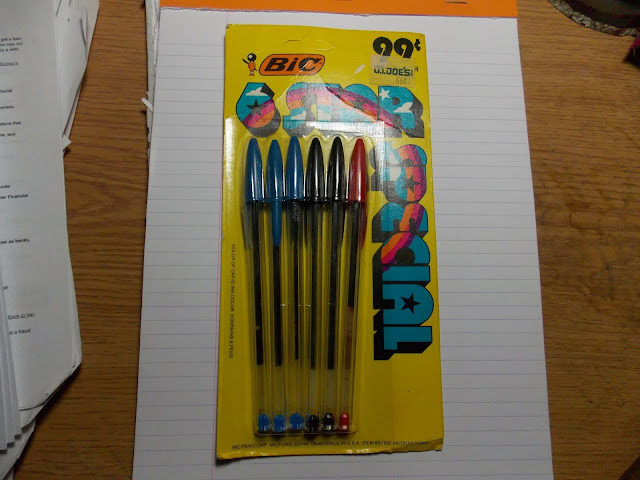
Someone rummaging through a school supply closet will almost certainly find a BIC Cristal from some unknown decade. The cap is probably still on. The ink is probably still good. That’s the whole point of the thing.
Old BIC pens are everywhere because they were made to be everywhere — cheap enough to buy by the box, durable enough to outlast whatever notebook they were paired with. But the story behind the old BIC models is more interesting than their price tag suggests. The original Cristal sits in the Museum of Modern Art. The BIC 4-Color became a French cultural icon. And several discontinued designs from the 1970s still have people actively hunting for them.
Here’s a real look at old BIC pens: where they came from, which models actually matter, and what separates a genuine find from an ordinary drawer-filler.
How the BIC Cristal Changed the Way the World Writes
László Bíró invented the ballpoint mechanism in 1938, but it was expensive and unreliable. Early ballpoint pens sold for $12.50 at Gimbels department store in New York in 1945 — roughly $200 in today’s money. They leaked, skipped, and were treated as luxury objects.
Marcel Bich, a French-Italian businessman, bought Bíró’s patent in 1945 and spent four years in a factory in Clichy, France, engineering a better version. The BIC Cristal launched in France in 1950. By 1958, it arrived in the United States at 19 cents per pen — roughly $2 today. That price drop is the entire story. Bich understood that the ballpoint’s real potential was disposability, not prestige.
What the Original Design Actually Solved
Every element of the Cristal’s design solves a physical problem. The hexagonal barrel prevents rolling off desks. The transparent body shows remaining ink at a glance. The small hole near the cap end equalizes air pressure inside the barrel as ink depletes — that’s what keeps old BICs from leaking even after decades of storage. The tungsten carbide ball at the tip, 1mm in diameter and seated in a brass socket, lasts for approximately 3 kilometers of continuous writing.
The pen measures 149mm long and weighs under 6 grams. Those specs never changed because they didn’t need to. Hold a 1965 BIC Cristal next to a 2026 model and the functional differences are invisible. The branding on the barrel is slightly different. That’s mostly it.
This is the important context for understanding old BIC pens: you’re not looking at a product later improved into something better. The original design was essentially complete from the start.
Why the MoMA Collection Entry Matters
The Museum of Modern Art added the BIC Cristal to its permanent collection in 2006, in a category of everyday objects representing exceptional design. It sits alongside the Nokia 3310, the Post-it Note, and the London Underground map. The curatorial argument: the Cristal achieves its function with zero unnecessary elements. Every part does exactly one job. Nothing is decorative.
For people hunting old BIC pens, this matters because it confirms that the earliest American Cristals — the 1958–1965 versions with their original packaging and pre-standardized BIC logo — have genuine historical significance. They are not just old pens. They are early examples of one of the most widely recognized industrial designs of the 20th century. Finding sealed vintage stock from that era is genuinely uncommon, and those examples carry a different weight than a loose old Cristal pulled from a junk drawer.
The Old BIC Models Worth Knowing About
BIC built several distinct models over the decades. Some are still made today; others were quietly discontinued. The table below covers the key ones.
| Model | Introduced | Key Feature | Current Status |
|---|---|---|---|
| BIC Cristal | 1950 | Hexagonal barrel, clear body, 1mm tungsten carbide tip, ~3km ink capacity | Still in production — essentially unchanged |
| BIC Clic | 1972 | First retractable BIC, color-banded barrel, click mechanism | Discontinued; replaced by BIC Clic Stic |
| BIC Round Stic | 1972 | Round barrel variant, lower price point than Cristal | Still in production |
| BIC 4-Color | 1970 | Four cartridges (black, blue, red, green) in one barrel | Still in production; older versions heavier with different proportions |
| BIC Orange | 1993 | Fine 0.8mm tip, orange accent barrel, popular in Europe | Still in production |
| BIC Soft Feel | Mid-1990s | Rubber grip barrel, ergonomic design, 1mm and 0.7mm options | Still in production |
The BIC Clic: The Discontinued Model With a Real Following
The original BIC Clic from 1972 is the most sought-after discontinued BIC model. It was BIC’s first retractable ballpoint — a response to pressure from Pentel and Paper Mate — and the early versions have a visual style that’s unmistakably 1970s: wider barrel bands, a chunkier click mechanism, and color combinations that don’t appear in any modern BIC line. Finding a working original Clic in its packaging from the early 1970s is genuinely uncommon. People used them; they didn’t collect them. That scarcity is real.
The BIC 4-Color and Its Place in School Culture
The BIC 4-Color launched in 1970 as the “Quadricolore” in France and became embedded in French school culture by the late 1970s. Students used red for corrections, blue for main text, and green for secondary notes — the same color system French teachers still sometimes enforce today. Original 1970s versions are heavier and have a different mechanism feel compared to the current model sold for around $5. If you’re comparing old versus new on this pen, the difference registers in the hand, not just in appearance. The older version has a denser, more deliberate click.
Whether Old BIC Pens Actually Still Write
Most of them will, yes. BIC’s oil-based ink doesn’t dry out the way water-based formulas do, so a Cristal sitting in a drawer for 25 years has a reasonable chance of writing the moment you uncap it. Scribble fast loops on scrap paper for 60 seconds if it skips — the tungsten ball just needs to pick up ink again after a long rest. The common failure modes are a cracked barrel from temperature changes or a seized ball from physical damage, not dried ink.
Old BIC Designs vs. Every “Improved” Version That Came After
The BIC Cristal from 1950 is still the right answer for almost all everyday writing, and newer BIC models don’t change that. Every ergonomic barrel, every rubber grip, every “premium” variant BIC introduced afterward was solving problems most writers don’t actually have.
The BIC Velocity Bold, sold at around $1.50 each, adds a wider rubber grip and a bolder 1.6mm tip. For someone with arthritis or grip fatigue, that’s genuinely useful. For general writing? The original Cristal’s 1mm tip is more controlled, and the hexagonal barrel doesn’t slip in normal use anyway.
The BIC Atlantis ($1.49 each), introduced in 2002, has smoother ink flow and a more comfortable barrel. It is measurably better than the original Cristal as a writing experience. But the Cristal at roughly $0.15 per pen does 90% of what the Atlantis does — and old Cristal designs prove the concept was already sound before any of those upgrades existed.
Where Newer BIC Products Genuinely Win
Two modern BIC lines actually improve on old designs in ways that are worth noting. The BIC Gel-ocity Quick Dry (around $7 for a 4-pack) uses gel ink that is noticeably smoother than any old BIC ballpoint formula — relevant if you write for long stretches where hand fatigue is real. The gel also dries faster than ballpoint ink, which matters for left-handed writers who regularly smear wet lines across a page.
The BIC Cristal Exact with its 0.7mm fine tip also writes more precisely than the classic 1mm model. Old BIC pens were never designed for fine annotation. If you’re writing in book margins or working with small handwriting, the Exact handles that job better. The vintage Cristal is not the tool for it.
When to Skip BIC Entirely
For fountain pen users who annotate books with specific ink colors and precise line widths, old or new BIC ballpoints are the wrong category. A Pilot Iroshizuku ink in a Lamy Safari produces a fundamentally different quality of line than any BIC ever will. For general readers who keep a pen in their book for underlining and the occasional margin note, though, a BIC Cristal — old or new — is still exactly right. It doesn’t bleed through most notebook paper, it doesn’t require a cap-tightening ritual, and it costs almost nothing to replace.
Five Mistakes People Make With Old BIC Pens
- Paying collector prices for common models. BIC made over 100 billion Cristals. An old one without original packaging, documented provenance, or any distinguishing historical feature is worth what a new one costs: about 15 cents. Don’t spend $15 or $20 on a “vintage” BIC ballpoint from an online marketplace unless it comes with verifiable original packaging from the 1960s or earlier. Old age alone is not a price driver when the production run numbered in the tens of billions.
- Assuming a non-writing BIC is permanently dead. Oil-based ballpoint ink doesn’t dry out like a marker. An old BIC that won’t write immediately just needs the ball reactivated. Scribble hard fast circles on rough paper for a full minute. If that doesn’t work, briefly warm the tip with body heat or run it under warm — not hot — water for a few seconds. Most old BICs revive this way. A pen that won’t write after both attempts probably has a physically damaged ball, which is not repairable.
- Mixing up the Cristal and the Round Stic. These are different pens with different histories. The Cristal has the hexagonal barrel and was the original flagship design. The Round Stic, introduced alongside the Clic in 1972, has a round barrel and was positioned as a lower-cost option. They use different ink formulations and produce different lines. Old Round Stics don’t carry the same design pedigree as the Cristal, and treating them as equivalent misses the distinction entirely.
- Overlooking the BIC 4-Color as the most historically interesting old BIC product after the Cristal. Original 1970s BIC 4-Color pens — especially French “Quadricolore” versions — are rarer than old Cristals because they were more expensive and less likely to be stockpiled. Students bought them one at a time. If you find one in original 1970s packaging at an estate sale or a French flea market, it warrants more attention than another loose Cristal. These are the old BIC models that actual stationery collectors track down.
- Expecting old BIC ink to perform identically on modern paper. The Cristal’s formula was developed for the thicker, less-processed paper stock common in the 1950s through 1970s. On today’s standard 80gsm copy paper — thinner, with a smoother surface — old BIC ink sometimes skips or shows more ghosting than modern formulations do. That’s not a sign the pen is defective. The paper changed. Old BIC pens write best on heavier notebook stock, index cards, or similar surfaces closer to what they were originally designed for.
The person who found an old BIC in a forgotten drawer and wondered if it still works — cap it off, scribble a few fast loops on scrap paper, and the answer is almost always yes. That’s exactly what a pen designed to cost 19 cents in 1958 was built to do: write, and keep writing, long past the point anyone expected it to.