Why Your Pencil Keeps Failing You at the Worst Moment
You are three pages into an exam. The lead snaps. Again. Or worse — it is not snapping, it is just scratching, barely leaving a mark because you have been pressing harder and harder without noticing the lead wore down to almost nothing.
This is not bad luck. It is a design problem.
Most mechanical pencils sold in school supply aisles are built around one priority: hitting a price point below $2. The plastic barrel is thin and flex-prone, the advance mechanism is loose, and the lead loaded inside is standard HB — fine for casual notes, genuinely bad for extended writing under pressure.
The core failure mode is not the pencil itself. It is the combination of wrong lead grade, unreliable advance rate, and a barrel that gives you no feedback to catch problems before they interrupt your work.
Here is what actually happens when lead breaks mid-session: you advance too much at once, the exposed lead catches at an angle on the paper, and leverage snaps it. Most cheap pencils advance 0.7mm or more per click. That is too much for fast writers. The lead hangs out, catches, breaks. Repeatedly.
The second failure mode is smearing. If you are left-handed, or writing in a workbook with limited clearance, a low-smear lead grade matters more than barrel finish. Standard HB in a humid room or on coated notebook paper smears badly enough to make revision marks genuinely unreadable by the end of a session.
And there is a third problem nobody names directly: inconsistent grip fatigue. A pencil that makes you unconsciously readjust your grip every few minutes — because it rotates, because the grip is slick, because the balance is off — costs you more mental energy than you notice. You just feel inexplicably tired at the end of two hours of notes.
Students spending $1.50 on a pencil every semester are often spending more in frustration and degraded work quality than if they had spent $5 once on something that actually works. That math holds up when you account for the time lost dealing with broken leads, illegible smeared margins, and grip exhaustion.
The question worth asking is: what does a genuinely reliable student pencil actually look like?
Four Factors That Separate Good Mechanical Pencils From Frustrating Ones
Before comparing any specific products, understand the four variables that actually drive pencil performance. Most reviews skip this entirely.
- Lead advance per click: Better pencils advance 0.3–0.5mm per click. Cheaper ones sometimes advance 0.7–1mm, which dramatically increases break risk during fast writing. A conservative, consistent advance means you stop thinking about the mechanism entirely — which is exactly what you want.
- Sleeve length and protection: A longer exposed sleeve lets more lead hang out, increasing break risk on sharp-angle strokes. For technical drawing, a long sleeve helps you see your lines. For note-taking, a short protected sleeve is more durable. The difference is particularly noticeable on spiral-bound notebooks where the sleeve can catch the wire binding mid-stroke.
- Barrel weight and balance: Heavy pencils (above 18g) reduce hand fatigue for detailed short-session work but tire your hand badly during two-hour lectures. Anything under 10g stays comfortable for long sessions. The weight difference seems trivial until you are ninety minutes into taking dense notes.
- Grip texture and material: Bare plastic grips rotate in your fingers when they get warm or slightly damp. Rubber-padded or knurled metal grips hold position. That rotational stability eliminates one of the main causes of unconscious grip readjustments — a small thing that compounds across a full semester of note-taking.
Those four variables explain most of why a pencil either becomes the one you automatically reach for every day, or ends up at the bottom of a drawer after a week.
What Students Get Wrong When Buying
The most common mistake: choosing lead size based on vague preference rather than actual use case. If you write small and fast with tight letterforms, 0.5mm is correct. If you write large, bold, or in notebooks with generous line spacing, 0.7mm breaks less and feels more natural. Buying 0.5mm because it sounds more precise when you actually write 0.7mm-style just creates unnecessary lead break frustration that gets blamed on whichever pencil you bought.
The Refill Problem Nobody Warns You About
Every mechanical pencil ships with a few sticks of lead. Once those are gone, most students buy whatever cheap refills are on sale. This is where pencil performance quietly falls apart. Generic bulk leads from unknown brands have inconsistent hardness ratings, higher break rates, and deposit graphite unevenly. The pencil gets blamed when the real culprit is a $2 refill pack. Getting the lead right matters as much as getting the pencil right.
Pentel P225 Specs: What the Numbers Mean in Practice
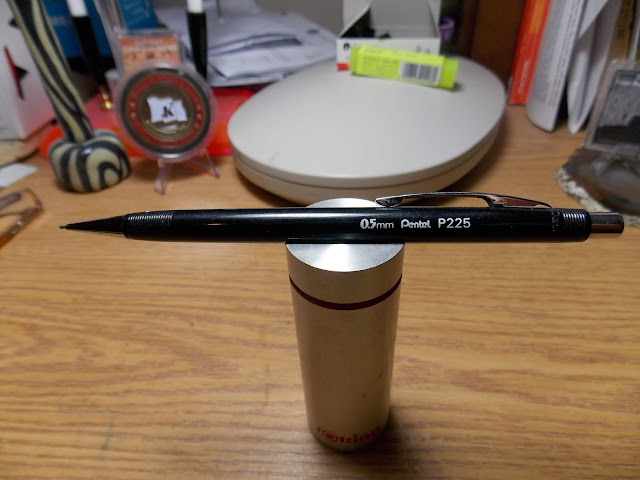
The Pentel P225 is a 0.5mm automatic pencil in Pentel’s P200 series — a line that has been in production in Japan for decades and has accumulated a loyal following among students, teachers, and casual writers. Here is the full spec sheet translated into practical terms:
| Specification | P225 Value | What It Means for Students |
|---|---|---|
| Lead diameter | 0.5mm | Standard for most writing; thin enough for small, dense handwriting |
| Body material | Plastic | Lightweight; survives drops but not being sat on |
| Body weight | ~9g | Light enough for long sessions without hand fatigue |
| Grip section | Rubber-padded | Prevents slipping; does not collect sweat like bare plastic |
| Sleeve type | Short fixed metal | Good lead protection; limits extreme-angle work |
| Eraser | Small twist-out under cap | Useful for spot fixes only, not heavy erasing |
| Lead advance | ~0.5mm per click | Conservative advance lowers break risk during fast writing |
| Price (single) | $3–$6 | Sub-$10 category; replaceable without budget guilt |
| Refillable | Yes | Accepts any standard 0.5mm leads |
| Country of origin | Japan | Consistent quality control versus generic alternatives |
The rubber grip section is the specific feature that justifies buying the P225 over a $1.50 generic. Not because it feels luxurious — it does not — but because it keeps the barrel in position during long writing sessions in a way that bare plastic physically cannot replicate. That is worth $3.
The eraser under the cap is the honest weak point. It is adequate for a quick letter correction. It is completely inadequate for erasing a paragraph. Budget for a separate block eraser and stop expecting the cap eraser to carry that load.
This is not a sponsored review. No affiliate arrangements exist .Pentel P225 vs. Four Real Competitors
The P225 competes in the $3–$12 daily-use student bracket. Here is how it stacks up against the four pencils most likely to appear on the same shortlist:
| Pencil | Price | Weight | Best Use Case | Main Weakness |
|---|---|---|---|---|
| Pentel P225 | $3–$6 | ~9g | Daily notes, long writing sessions | Eraser runs out fast; no break protection |
| Uni Kuru Toga Standard | $7–$10 | ~11g | Consistent line width over long sessions | Auto-rotation is paper-surface dependent |
| Pentel GraphGear 1000 | $15–$22 | ~16g | Technical drawing, precision drafting | Too heavy for two-hour note-taking |
| Rotring 600 | $35–$50 | ~22g | Professional architectural and illustration work | Price and weight overkill for students |
| Zebra DelGuard | $8–$11 | ~12g | Writers who break leads regardless of pencil | Break-protection mechanism adds noticeable bulk |
Bottom Line: The Uni Kuru Toga Standard ($7–$10) is the only real competition at the student price range. Its auto-rotating lead mechanism genuinely reduces uneven wear — if consistent line width matters to your work, the Kuru Toga earns the extra $3–$4. If it does not, the P225 is the lighter, simpler, less expensive choice.
The Pentel GraphGear 1000 is technically excellent but built for a completely different purpose. It has a retractable tip, a heavier knurled metal grip, and a balance point suited to short precise strokes. Buying it for lecture notes is like buying a standing drafting table for a dorm room.
The Rotring 600 is a precision instrument with a brass barrel and a fixed sleeve engineered for professional technical drawing. It costs more than most students spend on a week of groceries. Do not buy it unless you are in an architecture or engineering program doing actual technical drawings.
The Zebra DelGuard’s spring-loaded tip is a genuinely clever solution to one specific problem: chronic lead breakage caused by heavy grip pressure. If that describes you, the DelGuard solves it at the hardware level. The P225 does not.
Three Reasons to Skip the P225 Entirely
If you erase heavily and often, the P225’s built-in eraser will frustrate you before the second week ends. If you chronically break leads regardless of which pencil you use — usually a grip pressure issue — the Zebra DelGuard’s spring mechanism actually fixes that problem, and the P225 does not. And if your school requires 0.7mm leads for standardized answer sheets, buy the Pentel P207 and skip this conversation entirely.
Lead Grade Selection: The Spec That Matters More Than the Pencil
The pencil is the hardware. The lead grade is the software. Getting lead grade wrong quietly wastes whatever you spent on the barrel.
Which Lead Grade Should Students Default To?
Start with HB. It writes dark enough to read in low light, erases cleanly, and performs adequately on most paper types. It is not perfect for any specific use case, but it fails no one badly. That is why it ships as the default in nearly every mechanical pencil.
The case for going softer — B or 2B: if you write with a light hand by habit, HB can look faint by the end of a dense page. Softer grades deposit more graphite per stroke with less pressure applied. The tradeoff is more smearing and faster lead consumption. For humanities students taking long discursive notes, B-grade leads are worth a week’s trial.
The case for going harder — H or 2H: engineering and science students sketching force diagrams or circuit layouts benefit from the crispier, finer lines that harder grades produce. These grades also smear significantly less than HB. The tradeoff is that lines look lighter on the page, which some people find harder to read back under pressure.
Does the Brand of Lead Refill Matter?
More than most reviews admit. Pentel Super Hi-Polymer 0.5mm refills (~$3 for 12 sticks) write noticeably smoother than generic alternatives on most paper surfaces. The difference shows up clearly over long writing sessions — not in a 30-second side-by-side test.
Pilot Neox Graphite and Staedtler Mars Carbon are both strong alternatives when Pentel refills are not locally available. Both have consistent hardness ratings within a pack, which matters as much as the average quality of any single stick. Avoid no-name bulk packs unless you have personally tested them on your specific paper type.
When Should You Load a Fresh Refill?
Do not wait for the lead to run completely out before loading the next piece. Advance the current lead until roughly 3mm remains visible, then load a new stick from the reservoir under the cap. Trying to write with a 1–2mm stub causes it to fall through the sleeve into the barrel mechanism. Recovery involves shaking the pencil upside down over a trash bin while pressing the advance button repeatedly. Just load early.
The Verdict: Exactly Who Should Buy the Pentel P225
For students who want a reliable daily pencil at the lowest reasonable price, the Pentel P225 is the correct answer.
It is not the most technically advanced pencil at this price. The Uni Kuru Toga has a smarter lead mechanism. The Pentel GraphGear 1000 has a more refined grip. But the P225 has something most competitors in this range do not: it gets completely out of your way.
No mechanism to think about. No heavy barrel pulling your wrist down after ninety minutes of notes. No investment large enough to make you anxious about leaving it on a library desk.
At $3–$6, buying two and keeping one in every bag you own is financially trivial. That counts as a genuine feature in a category where the most common reason people buy a replacement is that they left the last one somewhere.
The specific recommendation: high school and college students taking handwritten notes, working through problem sets, or annotating reading assignments will get everything they need from the P225 without ever thinking about the pencil itself. For specialized work — architectural drafting, professional illustration, or standardized tests with specific equipment rules — there is a better-matched tool on this list. The P225 is not pretending to be anything other than what it is: a dependable, lightweight, daily-carry mechanical pencil that costs less than a coffee.
For most students in most situations, that is precisely the right thing to buy.