A student settles in at their desk in late March, journal open, the semester finally starting to make sense again. That spring reset — the one where people suddenly want to write things down, color-code their notes, and actually finish the books they abandoned in January — arrives around the same time as the first warm week. BIC pens, markers, and highlighters have been part of that ritual for decades, and knowing which products do what makes the difference between a spring writing habit that sticks and one that fades by May.
Why BIC Has Been the Classroom Standard Since 1950
The BIC Cristal ballpoint pen launched in 1950, created by Marcel Bich and Édouard Buffard in France. It wasn’t the first ballpoint — László Bíró holds that distinction — but it was the first one that most people could actually afford. Bich’s model was unusual for the era: make writing instruments disposable. That decision alarmed premium pen makers at the time, and eventually reshaped how entire generations learned to write.
The economics matter here. A BIC Cristal typically costs under $0.50 per pen when bought in multi-packs, and the ink cartridge holds roughly 2 kilometers of continuous writing. That figure has appeared in BIC’s marketing since the 1960s, and independent consumer testing has generally supported it. For a student writing five or six pages of notes daily, one Cristal typically lasts about two weeks of regular use.
This reliability — not innovation — is BIC’s actual value proposition. The tungsten carbide ball at the tip measures 1.0mm in the standard Cristal, producing a consistent line across different paper types and writing angles. Schools adopted it not because it was exciting but because it worked in the hands of eight-year-olds and eighteen-year-olds alike, day after day, without maintenance or careful storage.
Spring is when this matters most. After months of heavy academic use, students need fresh supplies heading into finals and spring projects. The BIC model — cheap enough to replace without guilt, consistent enough to trust — fits that window better than most alternatives at the same price point.
The Ballpoint Advantage on Paper
Ballpoint ink is oil-based, which means it dries almost immediately on contact with paper. This matters for left-handed writers, who deal with chronic smearing in gel and fountain pen systems. It also matters for anyone annotating books — oil-based ink doesn’t typically bleed through thin paperback pages the way water-based inks tend to under pressure.
Gel pens, including BIC’s own Gel-ocity line, offer smoother writing but introduce smearing risk on glossy or coated surfaces. For everyday spring journaling on standard 20lb paper, the original Cristal or BIC Round Stic is the lower-maintenance choice. Gel suits extended comfortable writing sessions; ballpoint suits reliability across uncertain conditions.
What the BIC Cristal Doesn’t Handle Well
BIC ballpoints typically perform poorly on heavily textured art paper — the ball skips and catches in the surface grain. They’re also not suited for calligraphy or brush lettering, where line variation depends on pressure changes. The Cristal’s ball delivers a consistent line regardless of pressure, which is exactly its strength and exactly why it fails at techniques that require variable line weight. If your spring project requires either of those things, the tool is working against you by design.
BIC Spring Product Comparison: Which Tool for Which Task
Not every BIC product serves the same purpose. Here’s how the main spring-relevant options compare across key use cases.
| Product | Best For | Approximate Price | Ink Type | Bleed-Through Risk |
|---|---|---|---|---|
| BIC Cristal Ballpoint (10-pack) | Notes, journaling, exams | $5–$7 | Oil-based ballpoint | Very low |
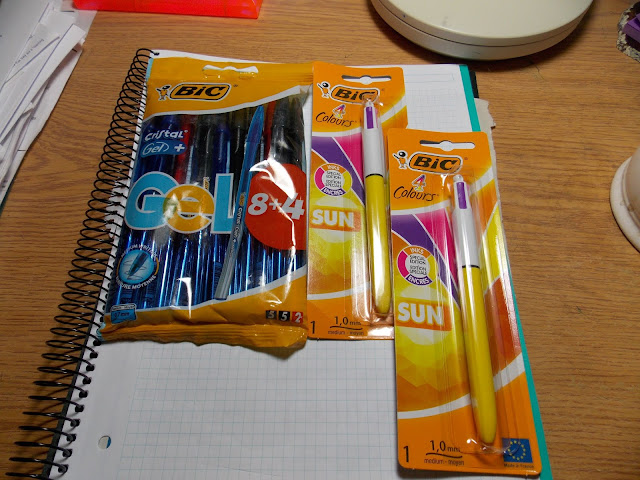
| BIC Gel-ocity Quick Dry (8-pack) | Long journal entries, smooth writing | $10–$15 | Gel, quick-dry formula | Low |
| BIC 4-Color Ballpoint Pen | Color-coded notes, bullet journals | $4–$6 each | Oil-based ballpoint, 4 colors | Very low |
| BIC Intensity Permanent Markers (12-set) | Art projects, labels, posters | $8–$12 | Permanent, alcohol-based | High on thin paper |
| BIC Brite Liner Highlighters (5-pack) | Textbook annotation, study guides | $4–$7 | Water-based fluorescent | Moderate |
| BIC Xtra-Smooth Mechanical Pencils (5-pack) | Math, drafts, erasable notes | $4–$6 | 0.7mm HB graphite | None |
The BIC 4-Color Ballpoint is the most underused product in this lineup for spring specifically. One pen, four ink colors, no separate marker case. For students building color-coded note systems or tracking multiple projects, it removes more friction than its $5 price tag suggests.
How to Build a Spring Journaling Routine With BIC Pens
Spring journaling is one of the more sustainable writing habits a person can start — the season provides natural structure that creates recurring moments to write. Shifting weather, end-of-semester deadlines, vacation gaps: all entry points. Here’s a system that typically holds past the initial two weeks.
- Pick one pen and use it for 30 days straight. The BIC Cristal in blue or black is the lowest-friction starting point — writes on nearly any paper, doesn’t require two-handed uncapping, and costs little enough that losing one doesn’t derail your routine.
- Use a dedicated notebook, not loose paper. Spring journaling fails most often when entries scatter across notebooks or app notes. A single notebook, consistently dated, creates a record worth returning to. The BIC Cristal writes cleanly on standard composition notebook pages and Leuchtturm1917 paper alike.
- Set a word floor, not a time limit. “Write for 10 minutes” is harder to keep than “write 100 words.” At average adult handwriting speed, 100 words with a BIC Cristal takes roughly 3–4 minutes — achievable even on a packed spring morning.
- Use the BIC 4-Color Ballpoint to mark entry types. One color per category: blue for daily logs, red for entries worth reviewing later. Two categories, not six. More than that typically collapses within two weeks when the novelty fades.
- Switch to BIC Gel-ocity Quick Dry for longer weekend sessions. If Saturday morning is your extended writing time — a week review, a personal reflection — gel reduces hand fatigue compared to ballpoint for sessions over 20 minutes. The Quick Dry formula handles most notebook paper without smearing.
- Highlight your own writing with BIC Brite Liner after the first month. Going back and marking one sentence per entry that surprised you is a useful reflection practice. The chisel tip (5mm wide) is precise enough for single-sentence annotation without flooding the page.
Choosing the Right Entry Length for Spring
Spring offers natural prompts: what changed since January, what you abandoned and why, what you’re revisiting now that the weather shifted. April and May are particularly good months to track decisions and deadlines you’ll want to reference later. A spring journal with 60–90 entries is, in most cases, more useful as a personal document than a year-round journal kept sporadically — the seasonal constraint creates density.
Bullet Journaling With BIC
The BIC 4-Color Ballpoint handles standard bullet journal syntax in one pen: dots for tasks, dashes for notes, circles for events, each in a different color. No digging through a pencil case mid-spread. The barrel is thick enough for most hands across a full weekly layout, though writers with smaller hands sometimes prefer the narrower BIC Round Stic grip for detailed index pages.
Spring Art and Book Annotation Projects With BIC Markers
For spring art projects, the BIC Intensity Permanent Marker 12-set ($8–$12) is the right call — but only if you’re working on paper heavy enough to handle it.
Alcohol-based permanent markers bleed through paper under 60lb (160gsm). That rules out most composition notebook pages and standard printer paper. For spring projects — botanical illustrations, spring-themed zines, illustrated book covers — use 80lb cardstock or Bristol board. On those surfaces, BIC Intensity delivers consistent color saturation with a chisel tip that handles fine-line detail and broader fills without switching tools.
For book annotation, the BIC Intensity is the wrong tool entirely. Permanent marker bleeds through most paperback pages and damages the text on the reverse side. The BIC Brite Liner highlighters (water-based) are the safer choice for textbooks and paperbacks — though it’s worth testing on a corner page before marking throughout any book you plan to keep.
A Three-Color Annotation System for Spring Reading
Spring — with longer days and vacation time — is a natural moment to establish a consistent book-marking system. A simple three-color approach using BIC Brite Liners:
- Yellow (BIC Brite Liner Yellow): Key claims or arguments you agree with
- Pink (BIC Brite Liner Pink): Passages worth questioning or pushing back on
- Blue (BIC Brite Liner Blue/Turquoise): Lines worth copying into notes later
Three colors, three actions. Yellow gets referenced in discussion. Pink gets challenged in your journal. Blue gets transcribed. Simple enough to apply mid-reading, specific enough to be useful weeks later.
Illustrated Journaling: Combining BIC Products
One technique that works for spring illustrated journals: sketch the outline with a BIC Xtra-Smooth mechanical pencil (0.7mm HB), ink the lines with a fine-tip BIC Intensity Permanent Marker once the sketch is final, then erase the pencil marks after the ink fully dries. For color inside the inked areas, BIC Marking Washable Markers carry lower bleed risk than the permanent version on thinner cardstock. The full setup costs under $20 from any office or craft supply store.
When BIC Is the Wrong Tool for the Job
Skip BIC entirely if you’re writing in a Hobonichi Techo (52gsm Tomoe River paper), doing watercolor journaling, or practicing calligraphy. The Cristal’s ball scratches across ultrathin paper, and BIC Intensity markers bleed through it in seconds. For those applications, Staedtler Triplus Fineliners or ink formulas specifically designed for thin paper — such as Pilot Iroshizuku fountain pen inks paired with a fine-nib pen — are typically the more appropriate choices. BIC is optimized for reliability at low cost, and that optimization has genuine limits at the edges.
BIC Pens for Students During Spring Exam Season
Which BIC pen handles long exam writing sessions best?
The BIC Cristal Ballpoint in 1.0mm is the standard recommendation for extended exam writing. The grip is minimal — some writers find it slippery during two-hour sessions — but the low-resistance ball and consistent ink flow reduce the hand pressure required compared to pens that need more force. For exams running three hours or longer, the BIC Soft Feel Ballpoint adds a rubberized grip section and costs under $3 per pen. The BIC Cristal XL offers an extended barrel for writers who prefer more length in the hand.
Do BIC pens work reliably on standardized test answer sheets?
In most cases, yes. Scantron and standardized test sheets use paper coated to accept dark ink. The BIC Cristal in black writes consistently on these surfaces. Some testing organizations specify No. 2 pencil — in that case, the BIC Xtra-Smooth Mechanical Pencil (0.7mm HB) is the correct substitution. That pencil’s line darkness and hardness fall within the optical scanning range that most standardized answer sheets require.
Will BIC highlighters damage textbook pages during spring study?
The BIC Brite Liner is water-based and low-acid, so it typically doesn’t damage standard textbook paper when applied correctly. The main risk is over-saturation: pressing too hard or passing over the same line twice causes ink to seep through thinner pages. One light pass is generally sufficient for clear visibility. Avoid using the Brite Liner immediately over fresh gel pen ink — the highlighter’s moisture can smear gel applied within the last 30–60 minutes.
Matching BIC Products to Your Spring Paper Choices
The pen-to-paper pairing matters more than most casual writers expect. The wrong combination means wasted ink, reverse-side bleed-through, and surfaces that scratch rather than accept ink. Here’s a practical reference for the most common spring writing papers.
- Standard composition notebooks (24lb / 90gsm): BIC Cristal, BIC Round Stic, BIC Brite Liner with light pressure. Avoid BIC Intensity Permanent Markers.
- Leuchtturm1917 or Moleskine (100gsm): All BIC ballpoints and gel pens perform well. BIC Brite Liner safe. BIC Intensity acceptable with careful, single-pass strokes.
- Cardstock or Bristol board (80lb+): Full BIC lineup works reliably, including BIC Intensity markers at full pressure.
- Paperback book pages (typically 40–50gsm): BIC Cristal for margin notes only. BIC Brite Liner with very light pressure. No permanent markers.
- Standard printer paper (20lb / 75gsm): BIC ballpoints and mechanical pencils work well. BIC Brite Liner acceptable. BIC Intensity will show reverse-side bleed-through.
- Hobonichi or Tomoe River paper (52gsm): BIC Cristal will ghost and scratch slightly on this surface. Use a different brand for this paper type.
The Reliable Rule for BIC Ink and Paper
BIC ballpoints handle almost any paper without issue — that’s what they’re designed for. BIC Intensity markers require heavier paper. BIC Brite Liner sits in between: versatile, but not reliable on pages under 60gsm without testing first. When uncertain, test a corner before marking throughout a book or notebook you care about. That one extra step typically saves the frustration of ruined pages later.
That student from March eventually fills the journal, works through the spring semester, and reaches June with a stack of annotated books and a handful of Cristal pens worn down to their last few centimeters. The tools were never the point — but the right ones stop getting in the way, and BIC’s lineup, for all its ordinariness, reliably clears that bar.