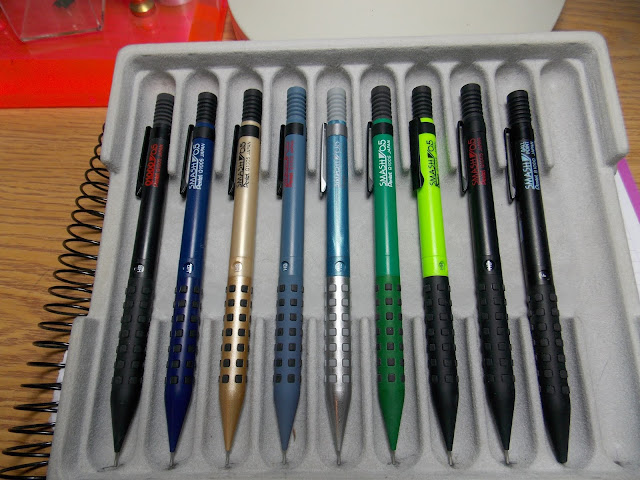
The Pentel Smash Q1005 has maintained a quiet following among students and stationery enthusiasts since the 1980s. At $12–18, it sits in a range where buyers want a clear reason to spend more than a generic pencil. There is one — but most people misidentify what it is.
What the Cushion Point System Actually Does
Standard mechanical pencils snap lead the same way every time. Writing pressure forces the guide pipe against paper fibers, the lead catches, and it fractures inside the barrel. The Pentel Smash addresses this with a cushion point mechanism — the guide pipe compresses about 1mm under force before returning to its extended position.
It functions like a suspension system for the lead. Pressure that would fracture a fixed pipe gets absorbed by the spring instead.
Why This Changes Long Study Sessions
Students writing 60–90 minutes per session encounter lead breakage as a recurring interruption. Stopping to advance lead, clearing a jammed piece from the barrel, losing focus mid-sentence. The cushion point reduces this significantly. The guide pipe sits at 4mm — long enough to see the writing path clearly, short enough that sideways pressure during fast writing won’t snap it.
The 4mm length is a deliberate result of iterative design. Shorter pipes reduce lead visibility under the tip; longer pipes increase breakage risk from lateral force during fast writing. Pentel landed on 4mm across multiple product generations and kept it there.
Weight, Balance, and the Grip Section
The Smash weighs 12g. That’s enough to feel controlled in the hand without fatiguing it over time. The rubber grip sits low on the barrel, pulling the center of gravity toward the fingertips rather than toward the top of the pencil. Top-heavy writing instruments cause subtle hand strain during long sessions. This design avoids that problem without requiring the user to adjust their grip.
The rubber texture is matte and moderately firm. Grippy enough for exam-day nerves, smooth enough that the material doesn’t ridge your fingers after an hour. It avoids both failure modes common in cheaper pencils: the aggressive ribbing that marks skin, and the smooth plastic that gets slippery as hands warm up.
The Fixed Guide Pipe — A Known Limitation
The 4mm guide pipe does not retract for storage. It is always exposed. For most students carrying a structured pencil case, this causes no issues — the pipe handles normal contact with other stationery without bending. If you store pencils loose in a backpack pocket alongside keys or other sharp items, either protect the tip with a small cap or factor this into your decision. The fixed pipe is a deliberate tradeoff: the retraction mechanism in pencils that offer it serves a completely different function from the Smash’s compression spring, and combining both would require a redesigned barrel.
Pentel Smash vs. the Four Main Rivals
Each of these pencils appears in the same searches as the Smash. They are not interchangeable. Picking the wrong one for your use case typically means buying twice.
| Pencil | Price | Guide Pipe | Weight | Best For |
|---|---|---|---|---|
| Pentel Smash Q1005 | $12–18 | 4mm fixed | 12g | Long writing sessions, note-taking |
| Uni Kuru Toga Roulette | $15–22 | Short fixed | 18g | Consistent line width, neat diagrams |
| Pentel GraphGear 1000 | $10–15 | 4mm retractable | 18g | Technical drawing, portability |
| Staedtler 925 35 | $20–28 | 4mm fixed | 15g | Drafting, ruler-based line work |
| Zebra DelGuard | $8–12 | Retractable guard | 10g | Budget anti-break focus |
Smash vs. Uni Kuru Toga Roulette
The Kuru Toga Roulette rotates the lead a fraction each time you lift the pencil from the paper, keeping the tip conical rather than developing a flat chisel edge on one side. For students who care about consistent line width — annotating diagrams, taking column-structured notes — the mechanism delivers genuine value. The Roulette model specifically adds a metal barrel that improves on the standard plastic Kuru Toga body.
The Smash wins on comfort for extended writing. The Roulette weighs 18g — 6g heavier — and its metal grip, while solid, does not match the rubber section on the Smash for marathon sessions. If you write more than an hour at a stretch, that weight difference registers by the end. Choose the Kuru Toga Roulette for diagram-heavy coursework. Choose the Smash for volume writing.
Smash vs. Pentel GraphGear 1000
Both are Pentel products. Both accept the same lead. The GraphGear 1000 has a retractable tip, an all-metal body at 18g, and a design originally aimed at technical drawing. It’s more portable and more durable under rough handling. The Smash’s cushion mechanism and lighter weight favor extended writing sessions over drafting precision. For classroom note-taking specifically, the Smash is the better tool. For anyone switching between writing, sketching, and technical work in the same session, the GraphGear 1000’s versatility justifies carrying the extra weight.
The Only Lead Grade Answer You Need
Use HB for general notes and exams. Use 2B if you write on textured or rougher paper, or want darker marks without increasing hand pressure. Anything harder than HB — H, 2H — scratches paper fibers and tires the hand within 30 minutes of continuous writing. The cushion mechanism works most effectively with softer leads: the spring compression does more useful work when the lead can flex slightly rather than being rigid. Match the lead grade to your actual paper type, not to what came in the package.
Four Mistakes That Ruin the Pentel Smash Experience
Almost every negative review of the Smash traces back to one of these four errors. None of them are product defects.
Mistake 1: Defaulting to 0.5mm Without Considering Your Writing Style
The Q1005 (0.5mm) works for most writers, but it’s not universal. The Q1003 (0.3mm) suits people with small, dense handwriting or anyone who annotates printed documents in tight margins — more content fits into less space. The Q1007 (0.7mm) works better for heavy-handed writers and slower styles where 0.5mm produces thin, scratchy lines. Each size is a separate pencil body: the lead mechanisms are not interchangeable between models. Consider your actual writing characteristics before defaulting to the most common option.
Mistake 2: Using Generic or Off-Brand Lead
The cushion point system reduces breakage but cannot compensate for brittle lead with inconsistent diameter. Quality lead from Pentel Ain Stein or Staedtler Mars Carbon is manufactured to tighter tolerances, breaks less frequently, and produces smoother strokes. Generic multi-packs from discount bins cause more breakage and a scratchier writing feel regardless of which pencil holds them. The pencil and lead function as a system — downgrading either half undercuts both.
Mistake 3: Expecting Drafting-Level Precision
The Smash is designed for writing comfort, not technical accuracy. Its rubber grip and cushion mechanism work against ruling fine lines along straight edges — the spring compression introduces slight inconsistency in pressure feedback that trained drafters notice immediately. Students who need precise geometric diagrams or architectural sketches should look at the Staedtler 925 35 or Rotring 600 ($35–45) instead. Both have knurled metal grips built for steady, controlled strokes against rulers. Using the Smash for that work isn’t impossible, but it’s fighting the tool’s design intent.
Mistake 4: Buying Multiple Sizes at Once to Test
The Q1003, Q1005, and Q1007 together cost $36–54 before lead. Most buyers who purchase all three simultaneously end up using one version and leaving the others unused. Start with the Q1005. Write with it for two weeks in your actual context — your real classes, your real paper, your real sessions. If you consistently wish the lines were finer or thicker after that period, you’ll know exactly which direction to move. The sequential approach saves $20–36 on redundant purchases.
Skip the Smash If Any of These Apply
The Pentel Smash is the wrong pencil for a meaningful number of buyers, and those buyers should spend their money differently.
If technical drafting is your primary use, buy the Staedtler 925 35 ($20–28). Its all-metal body and knurled grip outperform the Smash’s rubber section for precision line work against straight edges. The cushion compression that benefits writers becomes a liability for drafters who need consistent, unvarying pressure feedback.
If lead breakage is your only concern and budget matters, the Zebra DelGuard ($8–12) solves that specific problem more aggressively at a lower price. Its dual-guard mechanism prevents lead from snapping at any writing angle. It lacks the Smash’s build quality and grip comfort, but on anti-break performance alone, it wins at roughly half the cost.
If you’ve never used a mechanical pencil above $5 and aren’t confident the difference will register for you, start with the Pentel P205 ($5–8). Same brand, same lead standard, solid construction. A month of real use will tell you whether you notice the limitations — or whether you don’t, in which case you saved $10. Skipping the baseline makes it harder to appreciate what the Smash actually adds.
The Smash earns its reputation specifically with students writing 45 minutes or more per session. Light or occasional users — quick notes, signing documents, casual sketching — are paying a comfort premium they will never fully use.
Which Model to Actually Order
0.3mm, 0.5mm, or 0.7mm — which size is right for me?
Start with the Q1005 (0.5mm). It’s the version Pentel has optimized across the most design iterations and performs across the widest range of writing styles and paper types. Move to the Q1003 (0.3mm) if your handwriting is small or you frequently annotate printed documents where fine lines matter. Move to the Q1007 (0.7mm) if you write with consistent heavy pressure or find 0.5mm lines regularly too faint on your preferred paper.
Do the limited edition colors change anything about the pencil?
No. Pentel releases occasional colored barrel variants and translucent-body versions with identical internals to the standard black Q1005. Don’t pay a markup for aesthetics unless you specifically want them. The black barrel is the reference version and the one with the longest production history.
Is the Smash worth buying over the cheaper Pentel P205?
For students writing more than 30 minutes daily: yes. The P205 is a reliable pencil at $5–8, but it lacks the cushion mechanism and the rubber grip quality that make the Smash stand out in long sessions. The difference is perceptible within the first extended use. For occasional or light use — a few minutes at a time — the P205 is sufficient and the Smash is an unnecessary upgrade. Be honest about your actual use pattern before spending the difference.
Specific recommendation: the Q1005 with HB lead covers most students in most coursework. Writers on rougher or recycled paper, or anyone who finds themselves pressing harder to produce readable marks, should switch to 2B lead before considering any other change to their setup.
| Use Case | Best Pick | Reason |
|---|---|---|
| Daily lecture notes (60+ min) | Pentel Smash Q1005 | Cushion point, 12g weight, rubber grip |
| Uniform line width, diagram notes | Uni Kuru Toga Roulette | Lead rotation keeps tip consistently sharp |
| Technical drafting and ruler work | Staedtler 925 35 | Knurled grip, precision-focused build |
| Anti-break on a tight budget | Zebra DelGuard | Dual-guard system at the lowest price point |
| First mechanical pencil upgrade | Pentel P205 | Same brand quality, lower entry cost |