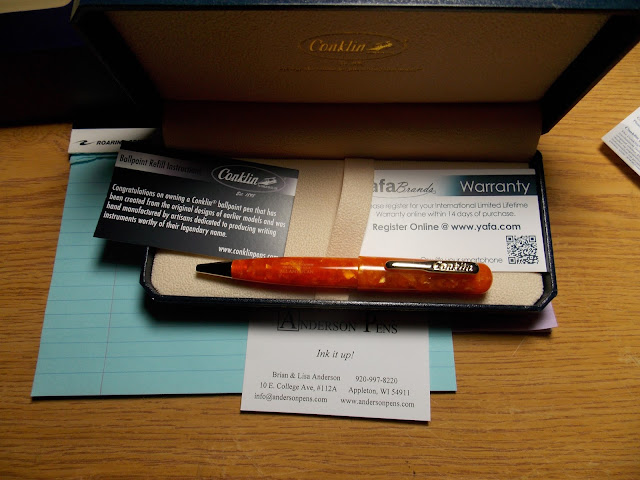
Most people think a ballpoint pen is a ballpoint pen. Pick one up at the drugstore, write a check, toss it in a drawer. That’s what I thought until I spent a semester grading essays and taking notes with three different pens strapped to my notebook. The Conklin Ball Point changed my mind—but not for the reasons I expected.
I write for a living. Between lesson plans, margin notes, and the occasional novel draft, I put down about 500 pages a month. Cheap pens cramp my hand. Fancy fountain pens leak in my bag. I needed something reliable, comfortable, and refillable. That search led me to Conklin, a brand better known for its fountain pens than its ballpoints.
This article covers the two most popular Conklin ballpoint models—the All-American and the Duragraph—and explains exactly who should buy them, who should skip them, and why they cost more than a pack of Bics.
Why Ballpoint Pens Still Matter in a Digital World
We type more than we write. But signing documents, filling out forms, and jotting quick notes still happen with ink on paper. A good ballpoint pen does three things that a keyboard or stylus cannot: it works on any paper, it never runs out of battery, and it forces your brain to slow down.
The fundamental problem a ballpoint solves is simple: delivering ink to paper without smudging, drying out, or leaking. The technology has been around since 1888, but the modern version—using a tiny rotating ball to dispense oil-based ink—was perfected in the 1940s. That basic mechanism hasn’t changed much.
What has changed is the build quality. Cheap ballpoints use plastic barrels and low-viscosity ink that skips and blobs. Premium ballpoints like the Conklin All-American Ballpoint ($45) use brass bodies, precise machining, and high-quality refills that write smoothly from the first stroke to the last.
The real value of a Conklin ballpoint isn’t the ink—it’s the feel. The weight, the balance, the way the twist mechanism clicks into place. Those details make writing less of a chore and more of a deliberate act.
Conklin All-American vs. Duragraph: Which One Should You Buy?
Conklin makes two main ballpoint models. They look similar at a glance, but the differences matter.
| Feature | Conklin All-American Ballpoint | Conklin Duragraph Ballpoint |
|---|---|---|
| Body material | Brass with resin or acrylic overlay | Brass with resin or acrylic overlay |
| Weight (without refill) | 34 grams | 31 grams |
| Length (capped) | 5.5 inches (140 mm) | 5.4 inches (137 mm) |
| Grip diameter | 10.5 mm | 11 mm |
| Retraction mechanism | Twist | Twist |
| Refill type | Conklin standard (Parker-style G2) | Conklin standard (Parker-style G2) |
| Price | $45 | $40 |
| Best for | Long writing sessions, larger hands | Pocket carry, smaller hands |
The All-American is slightly heavier and longer. That extra weight helps with fatigue because you don’t need to press down as hard. The Duragraph is a bit lighter and shorter, making it easier to clip in a shirt pocket or a notebook loop.
My pick: For daily note-taking and grading, the All-American wins. The extra 3 grams reduce hand strain over a full day of writing. If you carry your pen loose in a bag or pocket, the Duragraph is the better choice because it’s less likely to snag or feel bulky.
The One Thing Conklin Gets Wrong (And How to Fix It)
Out of the box, the Conklin Duragraph Ballpoint writes okay. Not great. The stock refill uses a medium point (1.0 mm) that lays down a thick, slightly draggy line. On cheap copy paper, it can feather a little. On glossy receipts, it skips.
This is the most common complaint I see from buyers. They spend $40 on a pen, uncap it, and get a writing experience that feels like a $2 Bic. The problem isn’t the pen—it’s the refill.
Conklin uses a standard Parker-style G2 refill. That means you can swap it for literally dozens of better options. Here are three that transform the pen:
- Schmidt P900M ($3.50) — Medium point, smooth, dark ink. This is the upgrade most people need. It writes like a gel pen but lasts like a ballpoint.
- Monteverde P44 Soft Roll ($4) — Fine point (0.7 mm), hybrid ink that combines oil and water. Dries fast, no smudging. Perfect for lefties.
- Uni Jetstream SXR-600 ($5) — The gold standard. Hybrid ink that feels like a rollerball. Smooth, skip-free, and available in 0.5 mm, 0.7 mm, and 1.0 mm tips.
Swap the refill before you judge the pen. The Duragraph with a Uni Jetstream refill writes better than pens costing three times as much.
Three Mistakes People Make When Buying a Conklin Ballpoint
Mistake #1: Expecting fountain-pen smoothness. A ballpoint uses thick oil-based ink. It will never feel as wet or effortless as a fountain pen. That’s a feature, not a bug—ballpoint ink dries instantly and won’t bleed through thin paper. If you want fountain-pen smoothness, buy a Conklin fountain pen instead.
Mistake #2: Ignoring the grip diameter. The All-American has a 10.5 mm grip. The Duragraph is 11 mm. That 0.5 mm difference sounds tiny, but it changes how your fingers wrap around the barrel. People with small hands often find the Duragraph more comfortable. People with large hands prefer the All-American. Test both if you can.
Mistake #3: Buying it as a gift for someone who hates heavy pens. At 31-34 grams, these pens are noticeably heavier than a plastic stick pen (about 8 grams). Some people love the heft. Others find it tiring. If you’re buying for a friend who uses disposable pens, start with a lighter option like the Parker Jotter ($15, 12 grams) or the Lamy 2000 Ballpoint ($60, 18 grams).
When You Should NOT Buy a Conklin Ballpoint
Conklin ballpoints are good pens. They are not the right pen for everyone. Here are three situations where you should look elsewhere.
Situation 1: You need a clicky pen. Both Conklin models use a twist mechanism. You twist the barrel to extend the refill and twist again to retract it. If you fidget with pens or need to click in and out constantly, the Parker Jotter ($15) or the Zebra Sarasa Grand ($10) offer satisfying click mechanisms at lower prices.
Situation 2: You write for hours with a death grip. The Conklin barrel is smooth resin or acrylic. It has no rubber grip or texture. If you squeeze the pen hard, your fingers will slide. For death-grip writers, a pen with a knurled or rubber section—like the Rotring 600 Ballpoint ($30)—will be more comfortable.
Situation 3: You want the absolute smoothest writing experience. Ballpoints have inherent friction. That’s how they work. If you want zero drag, buy a rollerball or a gel pen. The Pilot Precise V5 RT ($8) or the Uni-ball Signo 307 ($3) will write smoother than any ballpoint, including the Conklin.
The tradeoff is ink longevity. Rollerballs and gel pens run out faster than ballpoints. A Conklin refill lasts about 2,000 feet of writing—roughly three times longer than a gel refill.
How the Conklin Compares to Other Premium Ballpoints
The premium ballpoint market has clear leaders. Here is how the Conklin All-American stacks up against two direct competitors.
Parker Jotter ($15). The Jotter is lighter (12 grams), cheaper, and available in more colors. It uses the same Parker-style G2 refills as the Conklin. The Jotter’s click mechanism is legendary—crisp, loud, satisfying. The Conklin feels more substantial in the hand. For pocket carry, the Jotter wins. For long writing sessions, the Conklin wins.
Lamy 2000 Ballpoint ($60). The Lamy 2000 is a design icon. Makrolon body, 18 grams, smooth twist mechanism. It uses Lamy’s proprietary M16 refill, which writes beautifully but costs $5 per refill and comes in fewer sizes. The Conklin offers better value for the money—you get a metal pen at a lower price with more refill options. The Lamy 2000 is the better choice if you value minimalist design and don’t mind paying for proprietary refills.
Verdict: The Conklin All-American is the best sub-$50 metal ballpoint for people who write more than a page a day. It beats the Jotter on comfort and the Lamy on value. The only reason to skip it is if you need a click mechanism or prefer a lighter pen.
The Future of the Ballpoint Pen
Ballpoint pens are not going away. They are too practical. But the market is shifting. Cheap disposables still dominate, but more people are buying one good pen instead of fifty bad ones.
Conklin sits in an interesting spot. The brand has history—it started in Toledo, Ohio in 1898. But its ballpoints are modern. The twist mechanism is smooth. The brass body will last decades. And the refill compatibility means you are not locked into one writing feel.
The next time you sign a lease or scribble a note, ask yourself: does this pen feel good in my hand? If the answer is no, upgrade. The Conklin All-American Ballpoint is a solid place to start. Swap the refill, and you might never go back to plastic.