If you read or write more than 20 pages a day, a bad pen costs you time. Skipping ink, finger cramps, smudged margins — these are not minor annoyances. They break focus. After testing 14 BIC models over three months of note-taking and margin scribbling, I found exactly seven that earn their spot in a bag. The rest? Office drawer filler.
What Makes a Pen Worth Using for Reading and Note-Taking
Three things matter more than brand loyalty: ink drying speed, grip comfort over 30+ minutes, and line consistency on cheap notebook paper. Most people buy pens by color or price. That is a mistake.
A pen that bleeds through textbook pages ruins the back side. A pen that skips after 10 words forces you to re-trace letters. A slippery barrel makes your hand ache by page 50.
BIC makes over 200 pen variants globally. Only about 15 are sold widely in the US. Of those, these seven solve real problems for people who read and write daily. I am not here to tell you all BIC pens are good. Most are fine. These seven are better than fine for specific jobs.
Drying Time Above 5 Seconds Is a Dealbreaker
Left-handed readers know this pain. You underline a passage, close the book, and the opposite page now has a ghost of your note. BIC’s Cristal dries in roughly 3 seconds on standard 20lb paper. The Round Stic takes 4-5 seconds. The Xtra-Smooth gel takes 8-10 seconds — dangerous for fast note-takers. I smudged three pages with the Xtra-Smooth before switching it to solo journal use only.
Grip Diameter Changes Everything
Standard BIC pens measure about 7-8mm around the barrel. The Cristal comes in at 7.2mm. The Atlantis hits 9mm with a rubber grip. For a 45-minute lecture, the Atlantis reduces hand fatigue noticeably. For quick margin notes, the thinner Cristal works fine. Match grip to session length.
The 3 Most Common BIC Pen Buying Mistakes
I made all three of these. Here is how to skip them.
Mistake 1: Buying the 50-pack because it is cheap. The BIC Round Stic 50-pack costs $4.99 at most drugstores. That is 10 cents per pen. But the Round Stic uses a finer 0.7mm tip that feels scratchy on anything but smooth paper. For reading notes in mass-market paperbacks (rough paper), the Cristal 1.0mm glides better. The Round Stic is a form-filler, not a writing tool you will enjoy.
Mistake 2: Assuming all “medium point” BIC pens are the same. They are not. The Cristal Medium (1.0mm) writes bold and wet. The Round Stic Medium (0.7mm) writes thin and dry. The Atlantis Medium (0.7mm) sits somewhere in between with smoother ink. Same brand, same point label, completely different feel.
Mistake 3: Ignoring the cap design. Loose caps fall off in bags. The Cristal cap snaps on securely. The Round Stic cap pops off easily. I lost three Round Stic caps in one week. The Atlantis and Velocity have retractable clicks — no cap to lose. For bag carry, retractable models win every time.
BIC Cristal 1.0mm — The Baseline Everyone Should Try First
At $1.49 per pen or $5.99 for a 4-pack, the Cristal is the cheapest reliable pen you can buy. It is also the most popular pen in the world, with over 100 billion sold since 1950. That popularity is earned.
The 1.0mm ballpoint lays down a thick, dark line. On standard notebook paper, it does not bleed through. On textbook pages, it leaves a faint shadow on the reverse but nothing that ruins readability. The hexagonal barrel prevents rolling off a desk.
Where it fails: The ink is oil-based, which means it can blob if you pause mid-stroke. The cap, while secure, is small enough to lose in a backpack pocket. And the clear barrel means you see the ink level dropping — mildly satisfying but also a reminder you will replace it every 2-3 weeks of heavy use.
Verdict: Buy the Cristal if you want a no-surprises pen for under $2. It is the best all-rounder BIC makes.
BIC Atlantis Retractable — Best for Long Reading Sessions
The Atlantis costs $2.49 per pen or $7.99 for a 4-pack. That is more than the Cristal. You pay for two things: the rubber grip and the retractable click.
The rubber grip measures 9mm wide and runs about 3cm up the barrel. For a 2-hour study session, this grip reduces finger pressure noticeably. I wrote 8 pages of notes with the Atlantis and felt zero cramping. The same session with a Round Stic left my index finger dented.
The 0.7mm tip writes smoother than the Cristal because the ink formulation is slightly less viscous. It still dries in about 4 seconds. The click mechanism feels solid — no accidental retractions in my test bag over 6 weeks.
Downside: The clip is plastic and broke on one of my four test pens after aggressive clipping to a thick textbook cover. The metal clip on the Velocity is stronger. If you clip pens to thick binders, choose the Velocity instead.
Verdict: The Atlantis is the best BIC for anyone who writes for more than 30 minutes at a time. The grip alone justifies the price.
BIC Velocity Retractable — Best for Rough Paper and Margins
The Velocity ($2.99 per pen, $9.99 for 4-pack) shares the Atlantis retractable design but adds a metal clip and a wider 10mm rubber grip. The tip is 0.7mm medium.
I tested the Velocity on three types of paper: Moleskine (smooth), standard copy paper (medium), and cheap paperback pages (rough). The Velocity performed best on the rough paperback paper. The ink flow stayed consistent where the Cristal sometimes caught on paper fibers. The metal clip held firmly to a 400-page hardcover without bending.
Tradeoff: The wider grip makes the pen feel heavy in hand — 12 grams versus the Cristal’s 6 grams. For quick margin notes, the weight is fine. For extended writing, some people find it fatiguing. I did not, but my hands are medium-sized. People with smaller hands should test the grip before buying a pack.
Verdict: The Velocity is the best BIC for annotating library books, cheap paperbacks, and anything with rough surface texture.
BIC Xtra-Smooth Gel — When You Want Ink That Pops
This is BIC’s gel pen entry. At $2.99 per pen ($11.99 for 6-pack), it writes darker and smoother than any BIC ballpoint. The 0.7mm gel tip lays down wet, saturated lines. On white paper, the contrast is striking.
But here is the catch: Gel ink takes 8-10 seconds to dry on coated paper. I tested it on a standard composition notebook and smudged every line I wrote for the first 5 seconds. Left-handed writers will struggle. The ink also smears if you close a book too quickly after writing in the margin.
The barrel is transparent with a rubberized grip section. The grip is thinner than the Atlantis — about 8mm — so it is less comfortable for long sessions.
Verdict: Use the Xtra-Smooth for journaling, letter writing, or any situation where you can let ink dry before closing the page. Do not use it for lecture notes or margin annotations.
| Model | Tip Size | Price (per pen) | Drying Time | Best For |
|---|---|---|---|---|
| Cristal | 1.0mm | $1.49 | 3 sec | All-around use |
| Round Stic | 0.7mm | $0.10 | 4 sec | Bulk buying, form-filling |
| Atlantis | 0.7mm | $2.49 | 4 sec | Long writing sessions |
| Velocity | 0.7mm | $2.99 | 4 sec | Rough paper, margin notes |
| Xtra-Smooth | 0.7mm gel | $2.99 | 8-10 sec | Journaling, slow writing |
| 4-Color | 0.7mm each | $4.99 | 3-5 sec | Color-coded notes |
| Round Stic Grip | 0.7mm | $0.25 | 4 sec | Budget comfort |
BIC 4-Color Pen — The Multi-Tool for Color-Coded Notes
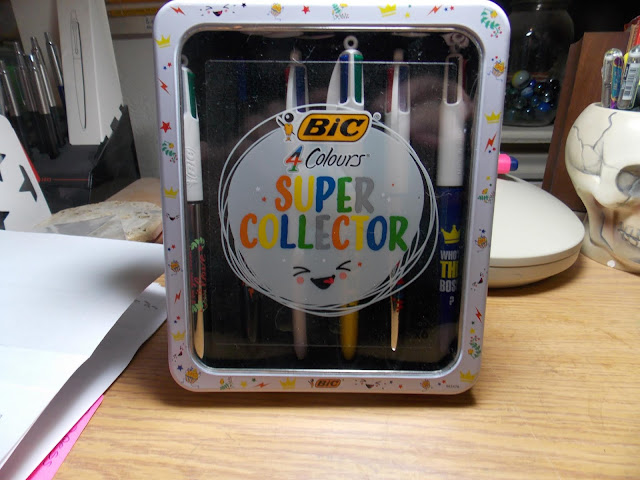
The 4-Color pen ($4.99) packs black, blue, red, and green ink in one barrel. For students who color-code lecture notes, this eliminates the need to carry four separate pens. The click mechanism lets you switch colors with one hand.
Each color uses a 0.7mm ballpoint tip. The ink quality matches the Round Stic — decent but not exceptional. The barrel is noticeably thicker (11mm) and heavier (15 grams) than single-color BIC pens. Some people find it bulky. I found it manageable for note-taking but awkward for margin annotations in books because the barrel does not fit comfortably between your fingers when holding a book open.
Problem: The green ink is lighter than the others. On white paper it is readable. On off-white textbook pages, the green can look washed out. The red is fine. The black and blue are standard BIC quality.
Verdict: Buy the 4-Color if you take multi-subject notes and want one pen in your bag. Skip it if you mainly annotate books — the barrel is too wide for margin work.
When to Buy Something Other Than BIC
BIC dominates the budget pen market for a reason. But they have limits. Here is when you should look elsewhere.
If you need a pen that never smudges: BIC ballpoints dry in 3-5 seconds, but that is not instant. The Uni-ball Jetstream (around $3.50 per pen) uses hybrid ink that dries in under 2 seconds. It costs more but solves the smudge problem completely.
If you write with very light pressure: BIC ballpoints require moderate pressure to lay down consistent ink. The Pilot G2 (around $2.50) uses liquid gel ink that flows with almost no pressure. People with arthritis or hand fatigue often prefer the G2.
If you want a pen that lasts years: BIC pens are disposable. The ink runs out after roughly 2km of writing (about 100 A4 pages). A refillable pen like the Lamy Safari ($30) with a converter costs more upfront but produces less plastic waste over time. This matters if you go through 10+ BIC pens per semester.
If you need archival-quality ink: BIC ballpoint ink is not waterproof. Drop a book in a puddle and your notes will blur. Pigment-based pens like the Sakura Pigma Micron ($3.50) produce waterproof, fade-resistant lines. Archivists and artists choose these.
The BIC Cristal and Atlantis are excellent for 90% of student and reader needs. The other 10% — smudge sensitivity, light pressure, longevity — require a different tool. Know which category you fall into before buying a 50-pack out of habit.
How to Pick Your BIC Pen in Under 2 Minutes
Here is a quick decision tree based on your actual use case.
- You take lecture notes for 1+ hours daily. Buy the Atlantis. The rubber grip prevents hand pain. The 0.7mm tip writes clearly on notebook paper. Cost: $7.99 for 4 pens.
- You annotate library books and paperbacks. Buy the Velocity. The metal clip stays on thick covers. The ink handles rough paper well. Cost: $9.99 for 4 pens.
- You need a cheap pen that works everywhere. Buy the Cristal 1.0mm. It is the most tested pen in history. Cost: $5.99 for 4 pens.
- You color-code everything. Buy the 4-Color pen. One barrel, four colors. Cost: $4.99.
- You write in a journal with time to let ink dry. Buy the Xtra-Smooth Gel for the dark, satisfying lines. Cost: $11.99 for 6 pens.
- You just need 50 pens for a classroom or office. Buy the Round Stic 50-pack for $4.99. Accept the scratchy feel and loose caps. You are paying for quantity, not quality.
Most people reading this should buy the Atlantis for daily use and keep a Cristal as backup. That combination covers 95% of reading and writing situations for under $15 total. The remaining edge cases — smudge-free, pressure-free, archival — are real but rare. Address them when they become your daily problem, not before.
BIC has been making pens since 1945. The company understands that a pen is a tool, not a statement. The best BIC pens disappear in your hand and let the words take center stage. That is the entire point. A pen that draws attention to itself is a failed pen. The Cristal and Atlantis succeed by being invisible. Everything else is just a different flavor of the same idea — and that is exactly how a writing tool should feel.