You have three equations left on a timed test. Your lead snaps mid-number. You click more out, write one line, and it snaps again. This is not bad luck — it follows directly from how your pencil’s tip is engineered, and understanding that design decision changes every mechanical pencil purchase you make from here on.
The Three Ways Mechanical Pencils Keep Failing Students
The student mechanical pencil market is full of products that perform fine during a quick store test and collapse under real exam or study conditions. The failure patterns repeat across brands and price points, and they are all predictable once you know what to look for.
Lead Diameter and the Breakage Curve
Lead diameter sets the floor on how much lateral pressure the graphite core can handle before snapping. This is straightforward physics.
- 0.3mm: Ultra-precise lines, minimal structural strength. Snaps under light sideways pressure. Not practical for general academic writing.
- 0.5mm: The standard for student use. Handles moderate writing pressure cleanly in normal conditions.
- 0.7mm: More forgiving under heavy-handed pressure. Thicker lines limit precision but reduce snapping significantly for hard writers.
- 0.9mm: Near-unbreakable for writing tasks. Line width makes it unsuitable for equations or detailed notes.
Within the 0.5mm range — where most student pencils compete — the breakage differences between products come from sleeve design and grip stability, not from the lead itself.
Fixed vs. Retractable Sleeves: The Design Decision That Matters Most
The sleeve is the thin metal tube extending from the pencil tip that guides lead as it exits the barrel. Its behavior under writing pressure determines whether a 0.5mm lead survives a full exam session.
Retractable sleeves compress when pressed against a hard surface, which protects the tip during bag transport. That is useful. But during actual writing, even minor sleeve flex creates micro-movement at the exact point where lead exits the tip. That movement introduces hairline fractures in the lead core — invisible until the lead snaps completely under normal pressure 20 minutes later.
Fixed sleeves do not compress. The lead has consistent rigid support along its entire exposed length. This is why every serious drafting pencil — from the early precision tools used in engineering offices to modern Japanese technical pencils — uses a fixed sleeve. The practical trade-off: a protruding fixed sleeve is more vulnerable in a bag without a cap, and it cannot retract if accidentally pressed against hard objects.
This one design choice separates drafting pencils from general writing pencils. It is the most important technical differentiator to understand before purchasing in this category.
Grip Fatigue Over Long Writing Sessions
Grip problems are invisible for the first 20 minutes and fully apparent at the 90-minute mark.
Knurled metal grips feel precise and premium. Under sustained writing, the rigid surface creates consistent pressure points along the finger pads. For most writers, measurable fatigue sets in between the 60 and 90-minute mark. Rubber grips distribute pressure more evenly across the contact zone. Smooth plastic grips require more active gripping force to prevent slipping, which accelerates hand fatigue in a different way.
For multi-hour exams or long study sessions, grip material is a functional decision — not an aesthetic preference.
What the Pentel PG15 Actually Delivers
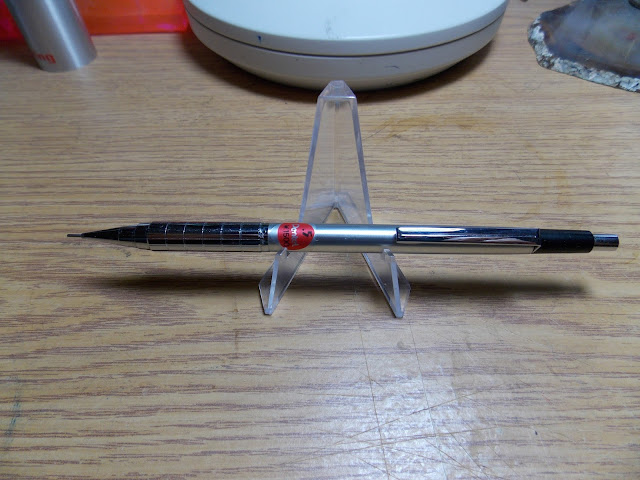
The Pentel PG15 is a fixed-sleeve, 0.5mm mechanical pencil from Pentel’s professional drafting line. It sits between their entry-level Sharp series and the premium GraphGear 1000 — more precise than a fashion writing pencil, more accessible in price than a full technical drafting tool. Here is the complete specification picture:
| Specification | Pentel PG15 Detail |
|---|---|
| Lead diameter | 0.5mm |
| Sleeve type | Fixed metal pipe, approximately 4mm exposed length |
| Grip material | Rubber, knurled texture, approximately 20mm grip section |
| Barrel material | Lightweight ABS plastic |
| Advance mechanism | Ratchet click, 0.5mm lead advance per click |
| Eraser | Small retractable eraser under top cap |
| Approximate weight | 12–14g |
| Overall length | Approximately 152mm |
| Retail price range | $7–$12 (varies by retailer and region) |
| Compatible leads | Pentel Ain Stein, Pentel Hi-Polymer, any standard 0.5mm lead |
Barrel, Grip, and Build Feel
The rubber grip section covers approximately 20mm — enough to span the full contact zone for most hand sizes. The knurling pattern provides directional friction without the hard edges that metal knurl delivers. In direct comparison with the Staedtler 925 25’s metal knurl grip, the PG15 rubber grip causes noticeably less finger fatigue across a 90-minute writing session for users with average to moderate grip pressure.
The plastic barrel keeps total weight around 12–14 grams. That is lighter than metal-accented drafting pencils like the Pentel GraphGear 1000 at approximately 17g, and significantly lighter than full-metal options like the Rotring 600 at approximately 28g. Low mass reduces hand and wrist fatigue during extended sessions in a measurable way. The plastic construction is a deliberate ergonomic choice, not a signal of cheap build quality.
Fixed Sleeve Performance for Drafting and Precision Work
The 4mm fixed metal sleeve allows clean ruler contact without gap errors between the pencil tip and the straight edge. For students working on engineering paper, physics diagrams, coordinate geometry, or architectural sketches, this is a direct practical advantage. The sleeve makes consistent contact with graph paper grid lines and drafting templates.
No other feature of the PG15 is as specifically valuable to STEM students as this one. The sleeve also holds the lead rigidly stable under writing pressure — no flex means no micro-fracture risk from tip movement. Under standard HB or 2B leads at normal writing pressure, lead breakage with the PG15 is rare.
The Eraser: Set Realistic Expectations Before You Buy
The retractable barrel eraser handles light spot corrections adequately. It is not a primary erasing tool. It will exhaust within a few heavy-correction sessions. If you erase frequently, carry a Pentel Hi-Polymer block eraser ($1–$2) or a Tombow MONO Zero precision eraser ($5–$7) for tight spaces. Expecting the barrel eraser to handle full-line or full-paragraph corrections is the single most common source of PG15 disappointment reported by users who bought it expecting a complete writing solution.
PG15 vs. Four Direct Competitors: Full Comparison
Prices vary significantly across retailers — differences of 30–40% on the same model are common between specialty stationery shops, office supply chains, and online sellers. The ranges below reflect standard retail. Always compare at least two sources before purchasing.
| Pencil | Price Range | Lead Sizes | Sleeve Type | Grip | Strongest Use Case |
|---|---|---|---|---|---|
| Pentel PG15 | $7–$12 | 0.5mm only | Fixed metal | Rubber | Drafting, ruler work, long writing sessions |
| Pentel GraphGear 1000 | $10–$14 | 0.3 / 0.5 / 0.7 / 0.9mm | Retractable metal | Knurled metal | Premium feel, tip protection for bag carry |
| Zebra DelGuard | $5–$8 | 0.3 / 0.5 / 0.7mm | Spring-loaded guard | Soft plastic | Heavy-handed writers, maximum lead protection |
| Staedtler 925 25 | $9–$13 | 0.3 / 0.5 / 0.7mm | Fixed metal | Knurled metal | Technical drawing, metal grip preference |
| Uni Kuru Toga Standard | $8–$11 | 0.3 / 0.5 / 0.7mm | Retractable | Rubber | Long note sessions, consistent point sharpness |
The Zebra DelGuard ($5–$8) is the correct choice if your primary problem is snapping leads under heavy pressure. Its dual-spring mechanism catches angled writing force before it reaches the lead core, preventing the fracture pattern that breaks standard leads mid-stroke. For hard writers, the DelGuard outperforms fixed-sleeve pencils in the one dimension that matters most to them. The trade-off: the spring mechanism cannot align flush with ruler edges the way a fixed sleeve does, so diagram and drafting work is less precise.
The Staedtler 925 25 ($9–$13) is the closest structural competitor to the PG15. Both use fixed metal sleeves with similar protrusion lengths. The Staedtler’s knurled metal grip feels more durable over years of heavy use. For short-burst technical drawing sessions, many users prefer the tactile feedback of metal knurl. For long daily writing, the PG15’s rubber grip wins on comfort. At similar price points, the decision is almost entirely about grip material preference.
The Uni Kuru Toga Standard ($8–$11) solves a completely different problem: its internal mechanism rotates the lead 9 degrees per stroke, maintaining a consistently conical point rather than developing the flat-edge wear that stationary leads show after extended writing. For students who fill multiple pages of dense prose daily, the Kuru Toga’s consistent sharpness is a genuine advantage the PG15 does not offer. For STEM diagram work where ruler alignment matters, the PG15’s fixed sleeve is the more relevant feature.
When a Fixed Sleeve Is the Wrong Tool for the Job
Fixed-sleeve pencils underperform in three situations: bag transport without a protective cap, where the exposed sleeve can bend or snag on bag contents; freehand artistic shading and cross-hatching, where lateral lead movement under the required pressure will snap 0.5mm leads reliably; and use by writers who consistently press hard enough to break leads even during straight-line writing. If your main use case fits any of these, a spring-loaded lead protection system or a retractable-sleeve pencil in 0.7mm will serve you better than any fixed-sleeve option.
Who Should Buy the Pentel PG15?
Is the PG15 the right daily driver for STEM students?
Yes — this is the PG15’s strongest use case, and the recommendation here is clear. Engineering, physics, chemistry, and mathematics students who work regularly with graph paper, diagram templates, or rulers get direct practical value from the fixed metal sleeve. The 0.5mm lead handles both written notation and fine diagram labeling without requiring a second tool. The rubber grip holds up through multi-hour study sessions without creating the pressure-point fatigue that metal knurl accumulates over time.
Students whose coursework is primarily text-based — history, literature, social sciences — get less specific value from the fixed sleeve. The PG15 will work fine for them, but the Uni Kuru Toga ($8–$11) would serve them better with its consistent-point rotating mechanism designed specifically for high-volume prose writing.
What about students who frequently snap leads?
The PG15 is not the right first purchase for confirmed heavy-handed writers. The fixed sleeve is better than a retractable sleeve for reducing micro-fractures, but it does not actively absorb or redirect the downward and lateral pressure that heavy writers generate. The Zebra DelGuard ($5–$8) costs less, and its spring-loaded guard system prevents the specific fracture pattern that snaps leads for hard writers. If you already know you press heavily, start with the DelGuard. The PG15 is a better fit once you have developed lighter, more controlled writing pressure.
Does the PG15 hold its value compared to the GraphGear 1000?
At $7–$12, the PG15 delivers fixed-sleeve drafting performance that competes with pencils priced at $15–$20. Its only lead size being 0.5mm is a genuine limitation for users who need to switch between fine writing and broader shading or calculation work. The Pentel GraphGear 1000 ($10–$14) adds retractable tip protection and four lead size options for a modest premium — worth it if you need one pencil that handles bag carry, daily writing, and occasional 0.7mm or 0.3mm work.
For dedicated desk use by a student who stores the PG15 in a pencil case rather than loose in a bag, the price-to-performance ratio is strong. Pentel’s Ain Stein 0.5mm leads ($3–$5 per tube) pair well with this pencil and are widely available across retailers. That supply chain consistency matters for a daily-use tool in a way that spec sheets never capture.
Quick comparison by buyer profile:
- STEM students using rulers and graph paper: Pentel PG15 ($7–$12) — fixed sleeve, rubber grip, built for precision desk work
- Writers who snap leads under heavy pressure: Zebra DelGuard ($5–$8) — spring protection system, stronger breakage prevention
- Users needing flexibility across lead sizes plus tip protection: Pentel GraphGear 1000 ($10–$14) — four sizes, retractable sleeve, metal grip
- Fixed sleeve with metal grip preference: Staedtler 925 25 ($9–$13) — same sleeve type as PG15, more durable grip material
- Long prose note-taking with consistent point sharpness: Uni Kuru Toga Standard ($8–$11) — rotating mechanism, even lead wear throughout sessions