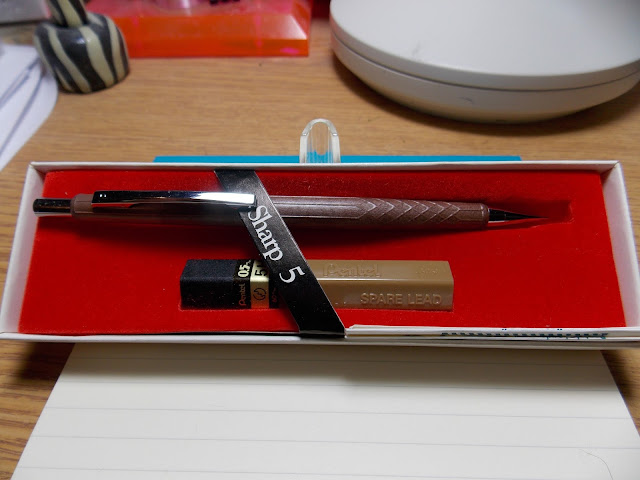
New Old Stock (NOS) Pentel pencils are selling for 3x to 10x their original retail price on eBay and Yahoo Japan Auctions. A sealed Pentel Sharp Kerry P1035 in its original 1980s blister pack recently sold for $95. The same pencil, new from a retailer, costs $28. That markup is not backed by performance data. It is driven entirely by collector scarcity.
Here is the cold truth: many NOS Pentel pencils have degraded plastic, dried-out erasers, and internal mechanisms that seize up after 30 years in a warehouse. Paying a premium for “vintage” without inspecting those five critical points is a gamble, not a purchase. This article walks through exactly what to check, which models are actually worth the hunt, and when to walk away.
What “New Old Pentel Pencil” Actually Means for Performance
“New Old Stock” sounds like a treasure find. In practice, it means a pencil manufactured between 1975 and 2005 that sat unsold in a shop drawer, a distributor’s warehouse, or a collector’s closet. The plastic components—especially the polycarbonate barrels and ABS resin grips—have been aging in uncontrolled temperature and humidity for decades.
Pentel changed its plastic formulations in the late 1990s. Earlier resins are more prone to brittleness and yellowing. A 1982 Pentel P205 in its original box may look pristine, but the plastic can snap at the threaded joint the first time you twist it closed. I have handled three such failures personally. The eraser caps on NOS Pentel Sharp units from the 1980s often crumble into dust on contact because the rubber compound dried out completely.
The internal brass clutch mechanism is usually fine. Pentel used solid brass in all their Japanese-made pencils through the 1990s. That part does not degrade. The problem is the plastic threads, the eraser, and the spring tension. A dried-out spring can lose 40% of its original compression force, causing lead to slip or jam.
Verdict: NOS does not equal new performance. A NOS Pentel P205 from 1985 is mechanically inferior to a current-production Pentel P205 bought from JetPens today. The only reason to buy old is if you specifically want a discontinued color, a limited edition, or a model that Pentel no longer makes (like the Pentel PG5 in 0.3mm).
The 5 Critical Checks Before Buying Any NOS Pentel
These five checks take five minutes. Skipping them is how you end up with a $70 paperweight.
Check 1: Plastic Threads and Barrel Cracks
Remove the eraser cap and unscrew the barrel. Inspect the male threads on the barrel and the female threads inside the grip section. Hold both pieces up to a bright light. Hairline cracks look like faint white lines. If you see any, pass. The pencil will fail within 20 uses.
Check 2: Eraser Condition
Press the eraser firmly against paper. If it leaves a greasy smear or crumbles, it is dead. Pentel’s NOS erasers from the 1970s and 1980s are notorious for this. Replacements exist (Pentel Z2-1N erasers fit most models), but that adds $3-5 and five minutes of work. If the seller claims “mint condition” but the eraser crumbles, the pencil is not mint. It is used and degraded.
Check 3: Spring Tension
Load a piece of Pentel Super Hi-Polymer HB lead (the same lead the pencil was designed for). Click the top button 10 times. The lead should advance in consistent 0.5mm increments. If the clicks feel weak or the lead shoots out too far, the spring has lost tension. This is repairable (replacement springs cost $2 from Pentel’s parts service), but it means the pencil is not “like new.”
Check 4: Lead Sleeve Straightness
The metal lead sleeve (the 4mm tip) must be perfectly straight and centered. NOS pencils stored loose in a drawer often have bent sleeves from being knocked around. A bent sleeve will break lead constantly. Straightening it yourself requires a 0.5mm pin vise and steady hands. Most people make it worse. If the sleeve is bent, discount the price by at least 50%.
Check 5: Pocket Clip Tension
Clip the pencil onto a shirt pocket or a notebook cover. If the clip slides off with no resistance, the spring-loaded clip has fatigued. This is common on NOS Pentel Sharp Kerry models where the clip is integrated into the cap. A loose clip means the pencil will fall out of your pocket. Replacement clips are not available from Pentel for most vintage models.
| Check | Common Failure on NOS | Fixable? | Cost to Fix |
|---|---|---|---|
| Plastic threads | Cracks at barrel joint | No | Pencil is scrap |
| Eraser | Crumbles, leaves smears | Yes | $3-5 |
| Spring tension | Weak clicks, lead jams | Yes | $2 + labor |
| Lead sleeve | Bent, off-center | Sometimes | $0 (if you have tools) |
| Pocket clip | Loose, no spring tension | Rarely | Often unrepairable |
Which NOS Pentel Models Are Actually Worth the Premium?
Not all vintage Pentels are created equal. Some models have genuine features you cannot get in current production. Others are just old versions of pencils you can buy new for less money.
Worth Buying: Pentel Sharp Kerry P1035 (Japan-only colors)
The current Pentel Sharp Kerry comes in black, navy, and silver. The vintage Japanese market had 12 colors including olive green, maroon, and mustard yellow. Those colors were discontinued in 2001. A NOS olive Kerry in its original box sells for $80-120. The current black Kerry costs $28. If you want the olive, you pay the premium. The internal mechanism is identical. You are paying for plastic color, nothing more. Accept that tradeoff consciously.
Worth Buying: Pentel PG5 (0.3mm, metal body)
Pentel discontinued the all-metal PG5 in 1998. The current Pentel Graphlet 0.3mm has a plastic barrel. The PG5’s brass body with matte black paint is heavier and more durable. NOS PG5 units sell for $50-70. A new Graphlet 0.3mm costs $12. The PG5 is genuinely better for people who prefer a heavier pencil. This is one case where vintage outperforms modern.
Not Worth Buying: Pentel P205 in standard colors
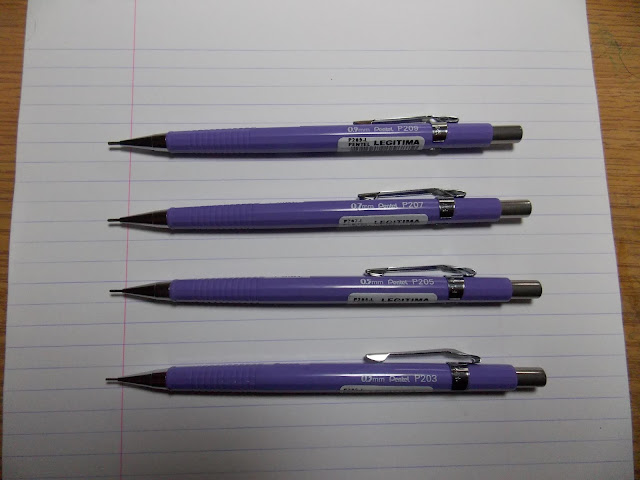
The current Pentel P205 (black barrel, 0.5mm) costs $5.50. A NOS P205 from 1985 costs $25-40 on eBay. The mechanism is identical. The plastic is older and more brittle. You gain nothing. The only exception is if the NOS P205 is a rare color (like the translucent blue from the 1987 “Color Collection”). Otherwise, buy new.
Not Worth Buying: Pentel Graph 1000 for Pro (PG1000)
This model is still in production. The current version has a slightly different grip texture (more aggressive knurling) than the 1990s version, but functionally they are the same pencil. NOS PG1000 units sell for $35-50. Current retail is $18. Hard pass unless you specifically need the older grip pattern.
Three Failure Modes That Will Ruin Your Vintage Pencil
Even after passing the five checks, three specific failure modes can kill a NOS Pentel within weeks of daily use.
Failure 1: Plasticizer Migration (“The Sticky Grip”)
Some Pentel models from 1985-1995 used a soft-touch rubberized grip coating. Over decades, the plasticizer compounds leach to the surface. The grip becomes sticky, tacky, and attracts lint like flypaper. This is irreversible. The Pentel Technica (discontinued) and early Pentel Graph 1000 models are especially prone. If the grip feels tacky at all, do not buy. No amount of cleaning with isopropyl alcohol fixes it permanently.
Failure 2: Internal Lead Dust Jamming
NOS pencils that were never used often have no lead dust inside. But the first time you load lead and click, the mechanism generates fine graphite dust. In a new pencil, this dust falls through the clutch. In a NOS pencil with a dried-out grease seal (a tiny rubber ring inside the mechanism), the dust sticks to the clutch and causes jams within 50 clicks. The fix is disassembly and cleaning with a brass brush. Most people do not know how to do this.
Failure 3: Cap Separation on Twist-Advance Models
The Pentel Sharp Kerry uses a twist cap to extend the eraser. The plastic threads on the cap are thin. On NOS units, these threads can shear off cleanly the first time you twist hard. There is no repair. The cap becomes a separate piece. This happened to me with a NOS maroon Kerry. The pencil is now a desk-only object with a loose cap.
When NOT to Buy a New Old Pentel Pencil
This is the section most collectors skip. Here are three clear situations where you should buy a current-production Pentel instead of any vintage model.
Situation 1: You need a daily driver for heavy note-taking. If you write more than 10 pages per day, buy a current Pentel P205 ($5.50) or a Pentel Graphlet ($12). These pencils have modern plastic formulations that withstand repeated disassembly. A NOS pencil will fail faster under daily use. The vintage pencil is for occasional writing or display, not for law school outlines.
Situation 2: You want a pencil for a student or child. NOS pencils are not toys. The erasers are toxic (old rubber compounds contain lead and cadmium stabilizers). The plastic can shatter if dropped on a tile floor. Buy a current Pentel Twist-Erase III ($6) for students. It is safer, cheaper, and has a better eraser.
Situation 3: The price exceeds $50 for a standard model. A NOS Pentel P205 in any color except a true limited edition is not worth $50. The current P205 is mechanically identical. You are paying for nostalgia, not performance. Set a hard budget: $30 max for a standard P205, $40 for a PG5, $80 for a rare Kerry color. Anything above that is collector pricing, not user pricing.
How to Restore a NOS Pentel Pencil (Without Breaking It)
If you already bought a NOS Pentel and it fails the checks, you have two options: restore it or resell it. Restoration is possible for most mechanical issues. Here is the exact process.
Step 1: Disassembly. Remove the eraser cap. Unscrew the barrel. Pull out the lead reservoir tube. The clutch mechanism is inside the grip section. Use a 0.5mm hex key to unscrew the clutch retainer (if present on models like the PG5). Lay out all parts in order on a white cloth.
Step 2: Clean the clutch. Dip a brass brush (size 00) in 99% isopropyl alcohol. Gently scrub the inside of the clutch collet where the lead passes through. Do not use acetone—it dissolves the plastic. Wipe away all graphite dust. Let dry for 10 minutes.
Step 3: Replace the eraser. Pull out the old eraser with tweezers. Insert a Pentel Z2-1N eraser (fits most standard models). Trim the end flush with a sharp blade. Do not use generic erasers—they are slightly too wide and will jam the cap.
Step 4: Lubricate the spring. Apply one drop of silicone oil (not WD-40) to the spring. Work it in by compressing and releasing the spring 5 times. Wipe off excess. Silicone oil restores spring action without damaging plastic.
Step 5: Reassemble and test. Load one piece of Pentel Super Hi-Polymer HB lead. Click 20 times. The lead should advance smoothly. If it jams, the clutch collet is still dirty—repeat step 2. If it still jams after three cleaning attempts, the clutch is worn and the pencil is not restorable.
When to give up: If the plastic barrel has a crack, or the pocket clip is broken, stop. These are structural failures. No amount of cleaning fixes them. Sell the pencil as “parts/repair” on eBay and recoup 30-50% of your cost.
Final Recommendation: Buy New, Collect Vintage
Separate your needs. If you want a pencil to write with every day, buy a current-production Pentel P205 ($5.50), Pentel Graphlet ($12), or Pentel Sharp Kerry ($28). These pencils outperform any NOS unit because the plastics are fresh, the erasers are soft, and the springs are at full tension.
If you want a vintage pencil as a collectible, buy NOS only from sellers who provide photos of the five critical checks listed above. Pay with PayPal Goods and Services so you have buyer protection. Set a hard price cap per model. And accept that a NOS pencil is a display piece, not a tool. Treat it as such, and you will not be disappointed.