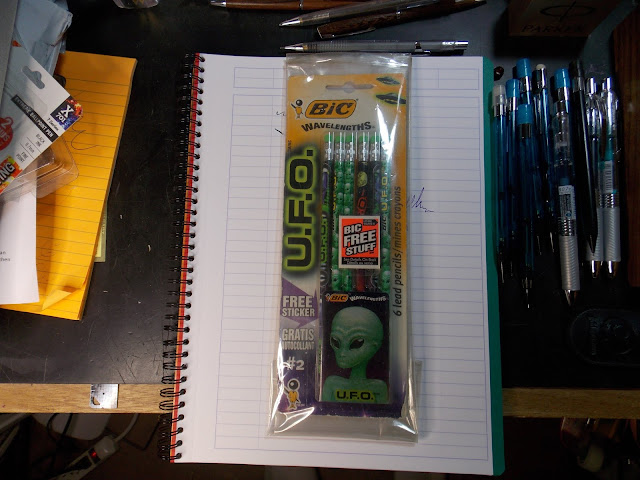
BIC #2 Pre-Sharpened Pencils at around $4 for 24 are the best bulk value in the pencil category — full stop. But most people misuse them: wrong sharpener, wrong pressure, wrong model for the task. The BIC Evolution is the smarter pick if you can spend $2 more. Here is how to actually get what you paid for, and exactly when a different brand is worth the upgrade.
The BIC Pencil Lineup, Ranked by Use Case
BIC makes six meaningfully different pencil products. Buying the wrong one is the most common mistake, and since the price differences are small, there is no good excuse for it.
| Model | Type | Lead | Approx. Price | Best For |
|---|---|---|---|---|
| BIC #2 Pre-Sharpened | Wood case | HB | $4 / 24-pack | Bulk school use, Scantron, SAT/ACT |
| BIC Evolution | Wood-free plastic body | HB | $6 / 12-pack | Drop-prone environments, heavy daily use |
| BIC Xtra-Smooth Mechanical | Mechanical | 0.7mm HB | $6 / 10-pack | Daily note-taking, consistent line width |
| BIC Xtra-Strong Mechanical | Mechanical | 0.9mm HB | $6 / 8-pack | Heavy writers, filling bubbles quickly |
| BIC Xtra-Precision Mechanical | Mechanical | 0.5mm HB | $7 / 6-pack | Technical diagrams, fine handwriting |
| BIC Criterium 550 | Mechanical, metal grip | 0.5mm | ~$10 / single | Long writing sessions, drafting |
Mechanical or Wood Case: Which Costs Less Over a Semester?
The 24-pack at $4 looks cheaper than any mechanical option until you run the numbers. A regular student sharpening frequently burns through that pack in six to eight weeks. A single BIC Xtra-Smooth Mechanical at $0.60 per unit, refilled with BIC HB lead refills ($3 for 40 pieces), can cover an entire semester of daily use.
For a classroom teacher buying supplies for 30 students, wood pencils win — you want something easily replaceable that no one needs to track. For a single student managing their own supplies, mechanical is almost always cheaper by March. Do the math for your situation before defaulting to the bulk box.
The One BIC Worth Actually Spending On
The BIC Criterium 550 gets overlooked because it is a single-pencil purchase in a market built around bulk buying. It has a knurled metal grip, a smooth lead advance that does not rattle, and it has been manufactured in France since the 1970s. At around $10, it sits between the disposable mechanicals and premium tools like the Pentel GraphGear 1000 ($15-20). College students who write by hand for three or more hours a day should try it at least once before assuming BIC only makes budget products.
How to Sharpen a Pencil Without Breaking the Tip
Most broken pencil tips are not a lead quality problem. They are a sharpener problem.
The cheap electric sharpeners mounted to classroom walls work by grinding at an inconsistent angle. They create micro-fractures in the graphite core that you cannot see. The tip looks sharp. It snaps on the first sentence you write. That is the sharpener’s fault, not BIC’s fault.
Sharpeners That Actually Work
- Kum Long Point 2-Hole Sharpener (~$8): Two-stage sharpening — one hole removes the wood casing, a second hole sharpens only the lead. Produces a longer, more structurally stable point than any single-blade sharpener. This is my everyday recommendation for anyone serious about pencil longevity.
- Staedtler 510 55 Metal Sharpener (~$4): All-metal body keeps the blade angle rigid under pressure. Plastic-body sharpeners flex slightly when you insert the pencil, which is exactly what causes uneven points and chipped edges along the graphite.
- Carl Decade Angel-5 Electric (~$25): The only electric sharpener worth trusting. It stops automatically at the correct point depth rather than grinding until you pull the pencil out manually. A one-time buy that makes sense if you or your student goes through ten or more pencils a week.
Avoid the $3 plastic barrel sharpeners sold in bulk bags at office supply stores. The blade drifts after the second or third use. They feel fine on day one and then they are quietly ruining every pencil you put in them.
Four Steps to a Point That Holds
- Rotate, do not push. Guide the pencil into the blade by rotating it smoothly, maintaining the same angle all the way around. Pushing straight in while twisting is what creates lopsided, asymmetrical points that snap unevenly.
- Stop before it looks done. A needle-fine tip breaks under normal writing pressure. Pull the pencil out when there is still a slight flat at the very tip — that extra half-millimeter of graphite is structural, not sloppiness.
- Tap the eraser end against your palm three times after sharpening. This dislodges wood dust and graphite particles packed against the lead inside the barrel. That debris is what causes the tip to catch and snap on the first stroke after sharpening.
- Write lighter on the first five strokes. The point is mechanically weakest immediately after sharpening. Let it seat against the paper before applying your full writing pressure — most breakage happens in this exact window.
How Long Should One Sharpening Actually Last?
Under normal note-taking conditions — roughly 200 to 400 words of handwriting — a properly sharpened BIC #2 holds a usable point for a full class period before it needs attention. For bubble-filling on standardized tests, one sharpening covers an entire two-hour exam section. If you are resharpening every twenty minutes, replace the sharpener before blaming the pencil.
Lead Hardness Grades: What HB, 2B, and 2H Mean in Practice
Every BIC pencil sold for school use is HB. That is the correct default for their market — but knowing where HB sits on the full scale tells you when to stop buying BIC and pick up something else entirely.
The scale runs from 9H (hardest, palest mark, slowest wear) to 9B (softest, darkest mark, fastest wear). Here is the breakdown that actually matters:
- H grades (2H, 4H, 6H): Hard graphite, light marks, precise lines. Architects and engineers use these for technical drafting where a dark smudge would obscure measurements. The Faber-Castell 9000 in 2H or 4H runs about $1.25 per pencil and is the standard tool for precision linework. BIC makes nothing in this range.
- HB: The middle of the scale. Dark enough to register on optical scanners and survive photocopying, hard enough not to smear from incidental page contact. Required for every standardized test that uses machine grading. BIC’s HB calibration is exactly right for this purpose — it fills ovals cleanly and does not over-darken.
- B grades (2B, 4B, 6B): Soft graphite, rich dark marks, high smear potential. Essential for shading, value rendering, and observational drawing. If you are doing any pencil artwork with tonal range, you need B-grade pencils — the Staedtler Mars Lumograph set or Faber-Castell 9000 in a multi-grade set are the standard choices here, not BIC.
The working rule: HB for anything that gets scanned, submitted, or photocopied. B grades for art. H grades for drafting. BIC only manufactures HB because that is who they are selling to — and they are right to stay in that lane.
Where BIC Pencils Fall Short
Do not use BIC pencils for drawing or shading. The HB lead is too hard for smooth value gradations, and the eraser leaves a waxy residue on anything smoother than standard copy paper. For visual art, buy a Faber-Castell 9000 Pencil Set spanning 2H to 6B ($12-15 for 12 pencils) and stop trying to make a school supply do a fine-art tool’s job. The same logic applies to smear-prone left-handed writers — BIC’s HB stays wet longer on the page than harder grades would, so if smearing is a consistent problem, a 2H from a different brand solves it faster than any technique adjustment will.
A Student Pencil Workflow That Actually Works
This setup eliminates the three most common student pencil failures: running out mid-exam, snapping tips at the worst possible moment, and losing expensive mechanical pencils that hurt to replace.
The Full Kit for Under $20
- BIC Evolution 12-pack (~$6) — drop-resistant plastic body, same HB lead as the standard wood version, will not splinter inside a pencil case when someone sits on it
- Kum Long Point 2-Hole Sharpener (~$8) — sharpen at home the night before class or exams; the two-stage system consistently produces more durable points than any wall-mounted sharpener in any school building
- Pentel Hi-Polymer Block Eraser (~$2) — the built-in BIC eraser handles light corrections without issue; the block eraser handles heavy erasing without tearing paper or leaving gray smears across the page
- A rigid pencil case that holds at least six pencils — soft pouches let pencils rattle and chip each other’s points; a hard case with individual slots is worth the extra dollar
Test Day Prep
Sharpen six pencils the night before any high-stakes test. Morning prep when you are rushed produces bad points and raises stress. Pack them point-up in a hard case. Bring one unsharpened spare. This feels like overkill until the second pencil tip snaps fifteen minutes into a two-hour exam and you are silently relieved you have four more.
Daily Note-Taking With Mechanical
If you take handwritten notes every day, the BIC Xtra-Smooth Mechanical in 0.7mm removes the sharpening problem entirely. No mid-class interruptions, no hunting for a sharpener, consistent line width from first page to last. Load it with BIC HB lead refills ($3 for 40 pieces) and you are covered for months. Writers who press hard and keep snapping 0.7mm tips should move to the BIC Xtra-Strong in 0.9mm — the thicker lead holds up significantly better under high-pressure writing styles and costs the same per unit.
BIC vs. Dixon Ticonderoga vs. Staedtler Noris
Is Dixon Ticonderoga Actually Better Than BIC?
In one specific way, yes. Dixon Ticonderoga #2 pencils (~$8-10 for 24) use a graphite mix that runs slightly softer within the HB range, producing a smoother stroke on standard paper. If you write with both back-to-back, the Ticonderoga glides more and the BIC scratches slightly more. For standardized tests and worksheets where you just need marks on a page, that difference does not affect outcomes. For daily journaling or long-form essay writing where you spend an hour or more at a stretch, the Ticonderoga is genuinely more comfortable. You are paying double per pencil for a real but modest improvement in feel — not a transformation.
What Does Staedtler Noris Offer That BIC Doesn’t?
The Staedtler Noris 120 (~$8-12 for 12) is what European schools issue as a classroom standard — the same default role BIC fills in American classrooms. The Noris lead sits slightly harder within the HB range, producing cleaner, crisper lines with less smear when pages press against each other in a binder. If your student stores a lot of handwritten notes and retrieves them weeks later, the Noris pages look cleaner. The tradeoff is that it erases marginally less completely on the first pass. For optical scanner tests where light marking is a risk, BIC’s softer HB fills ovals more confidently — that is actually worth considering for students who tend to mark lightly.
When to Spend More: Faber-Castell and Palomino Blackwing
The Faber-Castell 9000 starts at $1.25 per pencil. The Palomino Blackwing 602 runs about $2 per pencil ($24 for 12). The Blackwing has a legitimate following among professional writers, animators, and visual artists — the lead is noticeably silkier than any HB tool, and the flat eraser design with a replaceable slider is clever engineering. But a better writing experience is not the same thing as a better school pencil. Spending $24 on 12 Blackwings when three of them will disappear into a desk or a backpack by midterm is bad math regardless of how good they feel.
For most students, teachers, and anyone buying pencils in quantity: start with BIC Evolution for wood-pencil use and BIC Xtra-Smooth Mechanical for daily note-taking. If you want one meaningful quality upgrade, Dixon Ticonderoga at $8-10 for 24 is the right step. Save the Blackwing for when you are an adult who has decided handwriting is worth investing in — not for a pencil case that gets dumped out on a cafeteria floor twice a week.