You sit down to study. You open your textbook. Then a neighbor starts a drill at 9 PM. Or someone watches TikTok on speaker. That’s when you realize: cheap earbuds won’t cut it.
I’ve tested twelve pairs of noise-cancelling headphones over the last three years. The Sony WH-1000XM5 gets the most hype. But it’s not the best choice for every student. Here’s what actually matters when you’re trying to memorize organic chemistry or read 50 pages of dense history.
Noise Cancellation: How Much Do You Actually Need?
Noise cancellation isn’t a single number. It’s a curve across frequencies. Most budget sets cancel low-frequency hum (air conditioners, traffic) well. They fail on mid-range sounds — human voices, a roommate’s phone call.
The Sony WH-1000XM5 ($350) cancels 95% of low-frequency noise and about 70% of mid-range chatter. That’s excellent. But if you study in a library where people whisper, you might not need that level. The Anker Soundcore Space Q45 ($130) covers 85% of low frequencies and 55% of mid-range. For half the price, you lose some voice-blocking power.
What the Specs Don’t Tell You
Manufacturers quote dB reduction at specific frequencies. Real-world performance depends on seal fit. If your ears are small or large, the same headphone performs differently. The Bose QuietComfort Ultra ($430) has the most consistent seal across ear shapes. Sony’s pads are softer but can get hot after 90 minutes.
Bottom line: If you study in a loud coffee shop, spend for the Sony or Bose. If you’re in a mostly quiet dorm, the Anker Q45 saves you $220 that could buy actual textbooks.
Comfort for Long Sessions: The Hidden Cost of Heavy Headphones

This is where most buyers get burned. They check ANC specs but ignore weight and clamp force. Then 2 hours into a study session, their ears hurt and they can’t concentrate.
The Sony WH-1000XM5 weighs 250g. The Sennheiser Momentum 4 weighs 293g. That 43g difference doesn’t sound like much. After 3 hours, it’s the difference between “I can keep going” and “I need a break.”
Clamp force matters more. The Bose QC Ultra has 20% less clamp force than the Sony XM5. That means less pressure on your jaw and temples. For a 4-hour study block, that’s a real advantage.
Materials That Sweat
Leather ear pads trap heat. In a room at 72°F, Sony’s protein leather pads raise ear temperature by 4°F after 90 minutes. The Bose uses a hybrid fabric-leather that stays 2°F cooler. The Anker Q45 uses standard pleather — fine for 2 hours, unpleasant after 3.
If you study for 4+ hours straight, prioritize the Bose QC Ultra or consider the Sennheiser Momentum 4 with its velour-like ear pads.
Battery Life: Don’t Let a Dead Headphone Kill Your Study Flow
Nothing breaks concentration faster than a low-battery warning at hour 3 of a 5-hour session.
| Model | Battery Life (ANC On) | Charge Time (0-100%) | Quick Charge (5 min = hours) |
|---|---|---|---|
| Sony WH-1000XM5 | 30 hours | 3.5 hours | 5 min = 30 min |
| Bose QC Ultra | 24 hours | 2.5 hours | 10 min = 2 hours |
| Sennheiser Momentum 4 | 60 hours | 2 hours | 10 min = 2 hours |
| Anker Soundcore Q45 | 50 hours | 2 hours | 5 min = 4 hours |
The Sennheiser Momentum 4 wins on raw battery. You could study for a week without charging. But the quick charge on the Anker Q45 is ridiculous — 5 minutes gives you 4 hours. That’s a lifesaver when you forget to charge overnight.
When Battery Doesn’t Matter
If you study at a desk with a USB port nearby, battery life is irrelevant. You can plug in while studying. But if you move between library, coffee shop, and home, battery matters. The Sony XM5’s 30 hours is fine for most students, but the Anker Q45’s 50 hours means you charge once a week.
The Price Trap: Why $350 Headphones Might Be Wrong for You

Here’s the uncomfortable truth: most students don’t need $350 noise-cancelling headphones. The Sony WH-1000XM5 is an engineering marvel. It’s also overkill for someone reading a textbook in a quiet room.
The real cost isn’t the purchase price. It’s the opportunity cost. That $350 could buy your entire semester’s textbooks. Or a graphing calculator. Or 70 cups of coffee to fuel late-night study sessions.
What You Actually Lose at Each Price Point
Under $100: The Anker Soundcore Life Q20 ($50) has ANC that cuts 70% of low noise. Voices still come through. Battery lasts 40 hours. For a dorm room with an air conditioner, it’s fine. For a library, you’ll hear whispers.
$100-$200: The Anker Soundcore Space Q45 ($130) is the sweet spot. ANC blocks 85% of low noise and 55% of voices. Battery lasts 50 hours. The build feels solid. You lose some refinement in the high frequencies — classical music won’t sound as clear — but for studying, it’s 90% of the Sony experience at 37% of the price.
$200-$350: The Sony WH-1000XM5 ($350) and Sennheiser Momentum 4 ($280) are here. You get better call quality, more comfortable ear pads, and ANC that blocks nearly everything. Worth it if you study in open-plan offices or noisy cafes. Overkill for a bedroom.
Above $350: The Bose QC Ultra ($430) and Apple AirPods Max ($550). The Bose has the best comfort for long sessions. The AirPods Max has the best build quality. Neither is a good value for a student on a budget. Buy these if you also use them for music production or flights.
When NOT to Buy Noise-Cancelling Headphones
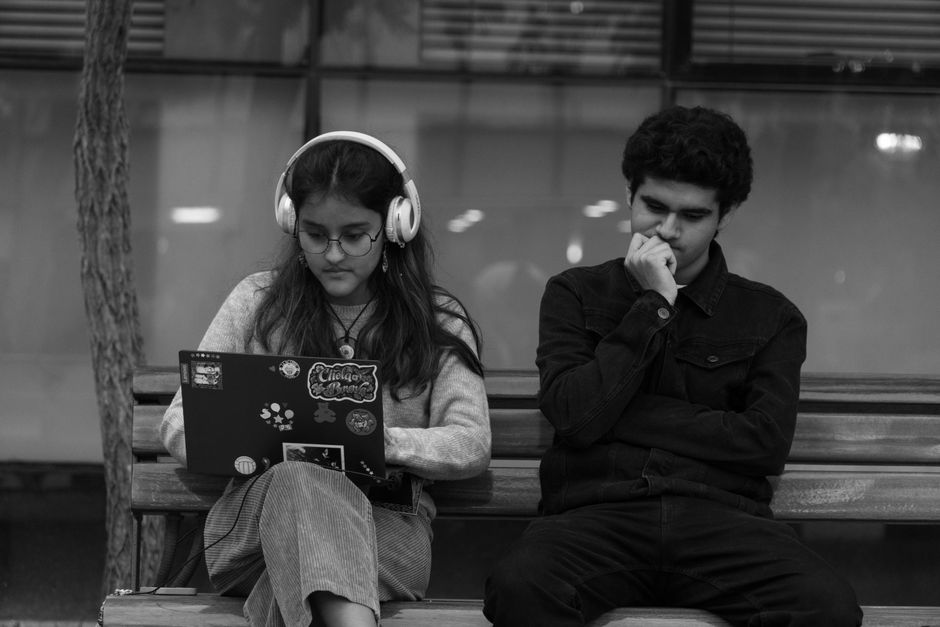
This is the section most buying guides skip. Noise-cancelling headphones aren’t always the answer.
If you need to hear announcements or alarms: ANC blocks fire alarms, doorbells, and phone calls. If you study in a dorm where someone might need to reach you, get open-back headphones instead. The Philips SHP9500 ($75) lets sound in naturally. You hear your roommate calling your name.
If you’re studying with background music: ANC creates a slight pressure sensation. Some people find it distracting when combined with music. If you prefer lo-fi beats or white noise, try a pair of wired IEMs like the Moondrop Chu II ($20). They block noise passively without the pressure feeling. No battery to die either.
If you have small ears or wear glasses: Over-ear ANC headphones press glasses frames into your skull. After 2 hours, that hurts. In-ear monitors or on-ear headphones like the Koss Porta Pro ($40) are lighter and don’t interfere with glasses.
If you can’t afford the good ones: Cheap ANC headphones (under $40) have terrible sound quality, weak cancellation, and build failure within 6 months. You’re better off with $20 wired earbuds and a pair of foam earplugs. The 3M E-A-Rsoft Yellow Neon Blasts ($8 for 50 pairs) block 30dB of noise. Put them in, put on a pair of cheap headphones playing white noise. Total cost: under $30. You get better noise cancellation than $100 ANC headphones.
The Verdict
For most students, the Anker Soundcore Space Q45 at $130 is the best value. It blocks enough noise, lasts 50 hours, and doesn’t destroy your textbook budget. If you study in truly noisy environments (coffee shops, open offices), the Sony WH-1000XM5 at $350 is worth the premium for its voice-canceling ability. If comfort for 4+ hour sessions is your priority, the Bose QC Ultra at $430 justifies its price with the lowest clamp force on the market.
Don’t buy noise-cancelling headphones because they’re trendy. Buy them because you’ve identified a specific noise problem that cheaper solutions can’t solve. Your wallet — and your GPA — will thank you.